|
The sixtieth Eurovision Song
Contest aimed from the outset to be a grand affair. There was even an
orchestra on hand for the intro and interval, in which Austria
conscripted any noteworthy composer who'd ever set foot in its
territory. The first song didn't appear for a good twenty minutes, but
there was a De Groot -like arrangement of mirror-balls to keep us
happy. When the songs did
arrive, the emergent theme was one of moody ballads that kick off about
a minute before the end, unleashing an explosive frenzy: Luxembourg on
steroids.
Serbia are something of a case in point, though they make that point in
a more up-beat way than most of the field. Their singer, Bojana
Stamenov, is the sort to make Malta jealous, and her masked colleagues
are marching with flags. But this one goes bigger in the hall than even
the first two verses suggest: the standard-bearers strip off their Eyes
Wide Shut garb for the full-on Gina G, while Stamenov growls with
increasing fervour. Many other potentially great songs fell by the
wayside by not pulling their rip-chord early enough.
Latvia come dressed as Diana Ross in the Chain Reaction video, but
there the similarity ends. Eartha Kitt performing the 1983 Spanish
entry on helium might come close to the moody eastern verse that could
make Bat For Lashes drool. Then we crack open into a Euphoric chorus,
and there's even a wub-wub break for the children. Also expressing
disinterest in the Luxembourgian model were Belgium, back to their
early '80s form (Pas de Deux would be proud): Loïc Nottet is like
the rebellious third Jedward triplet... the one who grew up in a
Eurovision kibbutz then somehow got into Kraftwerk and Carsten Nicolai.
They've found a groove and some Playback-style moves, and given them
the finesse of a classic Israel routine. Belgium, in other words, were
typically Belgium, and Belgium at their best.
Europe's winners were Sweden, which pleases us if only for the promise
of more Petra Mede. Måns Zelmerlöw begins deceptively, sat
down and listening to some steel guitar noises. He then unleashes his
gimmick, and we all love a good gimmick. His gimmick is a choreographed
back-projection animation with which he will interact throughout the
performance: fist-bumping a stick-man or punching out little farts of
light. It's very much the sort of nauseating crap you'd get in a mobile
phone ad, but it's well done. The chorus is overwhelmingly similar to
"The Rhythm of the Night" albeit toned down a touch for the grannies.
It's a competent song and they've put a lot of effort into the staging.
Contrast this with the UK, whose waffly versatile swing-doop could've
been an amazingly visual Strictly charleston fest, but instead they
blew the budget on some naff costumes that light up: the resulting
performance was very flat. They could've had Denise Van Outen entering
on an elephant or something.
Also not pulling their weight were guest stars Australia. This was no
Boom Boom Boomerang snadderdydang. Rather, they were still trapped in
the Ricky Martin infested waters of over a decade ago. They might've
put some effort in.
Imagine if BBC4's early-medieval art specialist Janina Ramirez got to
raid Servalan's wardrobe for a performance of King Lear. Georgia did.
Complete with an out-of-control smoke-machine, Georgia eschewed the
formula in favour of some banging repetition. The backdrop cries
mercury tears for she has no more worlds left to conquer (one suspects
she has Ruslana's head on a pike somewhere in all that smoke).
By the time the last act, Italy, took to the stage, we were pretty
drunk, and frankly defenseless against their come-to-bed implorings.
Their song demonstrates the evening's formula perfectly, but they've
marinaded the whole thing in a typically Italian ragu (doubtless handed
down in the Modugno family for generations) and the result is MacBusted
at the Opera. We were swept away by these happy men: it was our
favourite song of the night (though it was a close-run thing with
Belgium). It was also the winning song with the televote.
For each year's songs we
apply our points in the 12-10-8 style of the
modern contest, irrespective of how the voting functioned at the time.
In brackets is the position the song came on the night:
HERE
ARE THE VOTINGS
OF THE AVIEW JURY:
|
12pts
(3rd)
|

ITA
|
Il
Volo
"Grande amore" |
10pts
(4th)
|

BEL |
Loïc
Nottet
"Rhythm Inside" |
8pts
(6th)
|

LAT |
Aminata
"Love Injected"
|
7pts
(11th)
|

GEO |
Nina
Sublatti
"Warrior" |
6pts
(10th)
|

SRB |
Bojana
Stamenov
"Beauty Never Lies"
|
5pts
(=26th)
|

GER |
Ann
Sophie
"Black Smoke" |
4pts
(25th)
|

FRA |
Lisa
Angell
"N'oubliez pas" |
3pts
(8th)
|

NOR |
Mørland
& Debrah Scarlett
"A Monster Like Me" |
2pts
(16th)
|

ARM |
Genealogy
"Face the Shadow"
|
1pt
(14th)
|

SLO
|
Maraaya
"Here for You" |
Europe had Sweden first, Russia second, Australia fifth, Estonia
seventh, Israel ninth, Azerbaijan twelfth, Montenegro 13th, Romania
15th, Albanian 17th, Lithuania 18th, Greece 19th, Hungary 20th, Spain
21st, Cyprus 22nd, Poland 23rd, the United Kingdom 24th, and hosts
Austria joint-last on nul-points.
In the seven years since Wogan huffed off over the Eastern Bloc, six of
the seven winners have been from Old Europe.
|
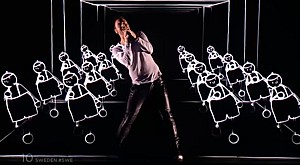
Sweden's winner now available on SlideShare.
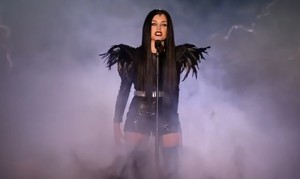
Georgia out of the ashes; seeking, rather than vengeance, retribution.
You were warned.
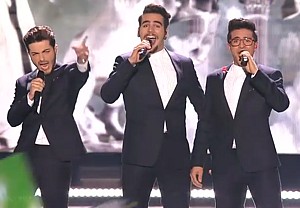
Italy stand by for action.
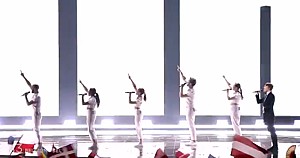
Belgium's tribute to Playback.
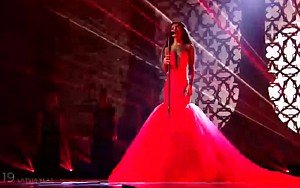
Latvia in the middle of a chain reaction.
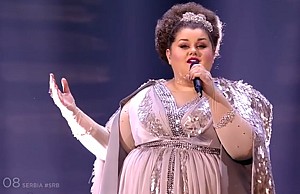
Serbia are different and that's ok.
POLITICS
|
Ukraine
failed to enter, citing financial and political reasons (i.e. Russia).
"Anti-booing technology" was used to disguise the response to the
Russian act.
Australia were invited to participate in honour of it being the 60th
contest and in recognition of the large Eurovision audience in that
country. Various clauses were introduced for the off-chance of a win,
but the details are now somewhat academic.
This year's excluded jury votes were Macedonia and Montenegro.
|
|