| France, having won three times,
decided to pass the buck of hosting the song contest on to the UK, who
were now firmly establishing themselves as the default foster-venue.
They used boom-microphones and multiple camera angles for a slick
televisual look, with many of the performances being rather beautifully
directed. Ronnie Carroll, in his second year of service for the UK,
found himself surrounded by a harem of female backing vocalists (one of
whom gave him a sober peck on the cheek at the end), while France's
Alain Barriere was haunted by the shimmering spectre of a wind-swept
woman during his spine-tingling rendition of a delicate tear-jerking
ballad. All the Scandinavian nations scored nul points with the exception of Denmark who won. The Netherlands also scored nul points; in their case for the second year in a row. For the second year running, our favourite was a passionate Spanish man wearing his bow-tie under his collar. His was a rousing martial ballad; rather charming. At the other extreme was the lively German entry, "Marcel"; all pizzicato strings and feist. Austria came up with a shimmering, Bond-like rumba with German and English lyrics, a haunting verse and a sensuous chorus. At the back end of the running order, two famous names (though more so now than then): Françoise Hardy and Nana Mouskouri; the latter with a better song than the former. The winning song (awash in the BBC's finest swirly graphic effects) came from Danish duo Grethe & Jørgen Ingmann, and there can be no doubting that it was a rather special entry: a man on an accoustic-electric guitar twanging out an at times eerie, at times jazzy, at times just plain dizzying 3/4 time number, while his wife sings beside him. These are truly the jazzier shores of Eurovision. The dance was simply entitled "Dansevise" (Dance Ballad). For each year's songs we apply our points in the 12-10-8 style of the modern contest, irrespective of how the voting functioned at the time. In brackets is the position the song came on the night:
Europe over-rated Switzerland yet again, placing it second. It also had the UK fourth, Monaco joint fifth, Yugoslavia eleventh, and Sweden and Finland joint last.
|
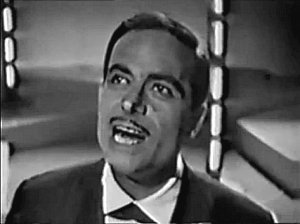 Our winner, José Guardiola. 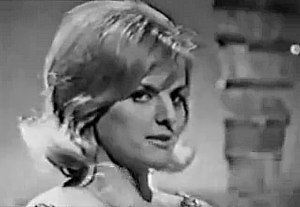 Germany's Heidi Brühl. 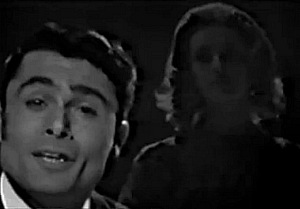 She's behind you!: Alain Barriere's ghost. 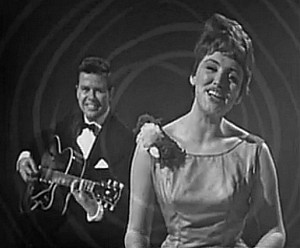 Europe's winner, "Dansevise". 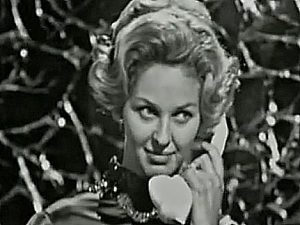 "The suspension is absolutely terrible." Katie Boyle untangles the scoring. |


