| 56 | 57 | 58 | 59 | ||||||
| 60 | 61 | 62 | 63 | 64 | 65 | 66 | 67 | 68 | 69 |
| 70 | 71 | 72 | 73 | 74 | 75 | 76 | 77 | 78 | 79 |
| 80 | 81 | 82 | 83 | 84 | 85 | 86 | 87 | 88 | 89 |
| 90 | 91 | 92 | 93 | 94 | 95 | 96 | 97 | 98 | 99 |
| 00 | 01 | 02 | 03 | 04 | 05 | 06 | 07 | 08 | 09 |
| 10 | 11 | 12 | 13 | 14 | 15 | 16 | 17 | 18 | 19 |
| 20 | 21 |
Fascist Spain arrived in 1961,
balanced by Communist Yugoslavia. It is fair to say that they weren't
very popular with the rest of Europe, though even in their debut year
the quality of Conchita Bautista shone through enough for them to get a
top ten placing. One can consider most of their '60s output as a work
in progress: an attempt to perfect a specifically Spanish sound, heavy
on sass and shimmy and thick with latin passion: effectively, an
attempt to create their 1969 entry. In this respect, 1968's "La La La"
stands out as different to the usual Spanish style, which perhaps
explains its popularity with the European voters as much as any of
Franco's alleged bungs.
Throughout their history, Spain have played the tourist card, offering straw donkeys of varying quality for our consumption. This sense of playing away has been of definite benefit: the Mediterranean nations have provided us with consistent respite from the central European core of Eurovision, and at no time was this more welcome than in the dark days of the '80s and '90s when predictable power ballads had nothing more to give than a contrasting middle-eight, and the sound of Irish pipes haunted the land. Spain offered something different (albeit seldom of a standard to appear in this top ten). That, coupled with their uninterrupted involvement and Big Five status, has earnt them the honour of being the nation to have been awarded the most points by our AView jury. That said, there's only one track that's made it to this list in the last thirty years...
Here, then, are our top ten Spanish entries:Throughout their history, Spain have played the tourist card, offering straw donkeys of varying quality for our consumption. This sense of playing away has been of definite benefit: the Mediterranean nations have provided us with consistent respite from the central European core of Eurovision, and at no time was this more welcome than in the dark days of the '80s and '90s when predictable power ballads had nothing more to give than a contrasting middle-eight, and the sound of Irish pipes haunted the land. Spain offered something different (albeit seldom of a standard to appear in this top ten). That, coupled with their uninterrupted involvement and Big Five status, has earnt them the honour of being the nation to have been awarded the most points by our AView jury. That said, there's only one track that's made it to this list in the last thirty years...
|
1pt |
1990 |
AV:
4th Eur: 5th |
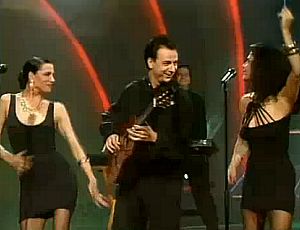
| Azúcar Moreno - "Bandido" | |||
|
A backing tape problem saw an
hilarious false start for the opening Spanish entry in 1990, showing up
the miming nature of the stage band. That's not why we ranked it so
highly. It's a good latin dance number with more than a hint of a call
to prayer, even if it does feel a lot, at times, like an episode of the
Clothes Show.
|
|||

|
2pts |
1966 | AV:
2nd Eur: =7th |
| Raphael - "Yo soy aquél" | |||
|
In 1966, Spain gave us the
legendary Raphael: a sort of Spanish Cliff Richard with hints of Norman
Wisdom if Norman Wisdom had been a plastic sex-toy. The song is a
powerful, stabby, soaring ballad (of the sort which would dominate in
later years, but done properly here, by an expert).
|
|||
|
3pts |
1973 | AV:
5th Eur: 2nd |
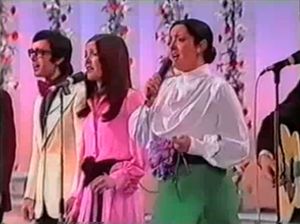
| Mocedades - "Eres tú" | |||
|
"Eres tú" was accused at
the time of ripping off the 1966 Yugoslavian entry "Brez besed", and,
let's face it, it does. This poses a bit of a problem, but it must be
said that the innovation is superior to the original invention here.
"Eres tú" would itself become a Eurovision classic, and
something of a prototype for future entrants: a building power-ballad
with a fantastic chorus-line and oddly poppy moments for such a folksy
looking outfit.
|
|||
|
4pts |
1980 | AV:
3rd Eur: 12th |
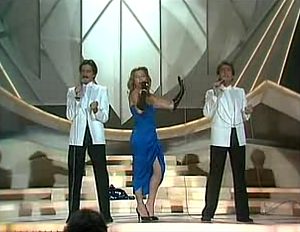
| Trigo Limpio - "Quédate esta noche" | |||
|
In 1980, Spain took to the
stage in evening-wear (the woman doing the increasingly standard cape
removal at half-time) for an at times quite haunting, at times rather
brassy and dramatic number (think "Live & Let Die" or "MacArthur
Park"). It's all very tense, but doesn't quite do enough with it.
|
|||
|
5pts |
1974 | AV:
2nd Eur: =9th |
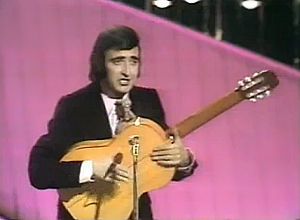
| Peret - "Canta y sé feliz" | |||
|
The Spanish entry of 1974 was
the most Spanish yet: singer Peret throwing his free-held guitar all
about the place, turning it backwards and hammering on the back at one
point, in an exciting and fun rumba fiesta to which the shouting of
"¡Olé!" is obligatory.
|
|||

|
6pts |
1968 | AV:
1st Eur: 1st |
| Massiel - "La, la, la" | |||
|
Universal nonsense sing-along
reached its zenith in 1968 with the excellent "La, la, la", complete
with moody minor verse and a joyous, tear-jerking exclamation of a
chorus. If a Francoist bribing spree did take place that year, it at
least served to create one of the few occasions when Europe agreed with
our own scoring. In another time, this song might do better in this
chart, but familiarity has taken its toll slightly, and allowed less
well known entries to gain over it the advantage of novelty.
|
|||

|
7pts |
1977 | AV:
7th Eur: 9th |
| Micky - "Enséñame a cantar" | |||
|
Sung by the buoyant, Roy
Castle-ish Micky accompanied on stage by three backing singers, a jug
blower and a seated young woman in silver cowboy boots pretending to
play a banjo, this is a happy-go-lucky affair rather reminiscent of
"Young at Heart" by The Bluebells, or even "I'd Like to Buy the World a
Coke". It possesses an infectious sense of joy, as might be found in a
curious uncle. It's rubbish in a way, but such delightful rubbish as
might be found in a bric-à-brac shop.
|
|||
|
8pts |
1983 | AV:
2nd Eur: =19th |
| Remedios Amaya - "¿Quién maneja mi barca?" | |||
|
Truly amazing. In a bold move
Spain went with a particularly hard-core Moorish flamenco, far from the
safety of European tonal conventions. The result is a loud, aggressive,
mechanical and profoundly North African performance. Petrifying stuff.
The wild Remedios Amaya, performing barefoot, flourishes her dress in
some wonderful semi-colons, though had she done a few more she might've
thawed the hearts of a few more juries and scored more than nul points.
Alas, we know how blinkered Eurovision judges can be.
|
|||

|
10pts |
1969 | AV:
2nd Eur: =1st |
| Salomé - "Vivo cantando" | |||
|
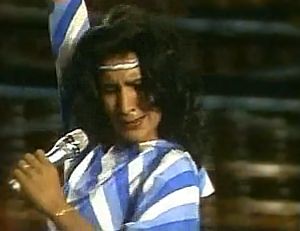
Spain's 1969 entry was pure
brilliance: delivered by the constantly shimmying Salomé in her
distinctive (and apparently rather heavy) blue porcelain-tasseled
jump-suit, the song starts inauspiciously before taking a chunk of
1965's entry "¡Qué bueno, qué bueno!", shaking it
about a bit, and then repeating it with increasing vigour and speed
until poor Salomé can shake no more.
|
|||
|
12pts |
2008 | AV:
1st Eur: 16th |
| Rodolfo Chikilicuatre - "Baila el Chiki-chiki" | |||
|
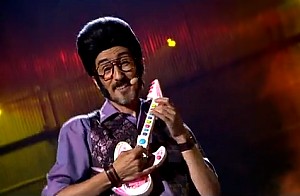
Bequiffed fictional comedy
character and inventor of the vibrator-guitar, Rodolfo Chikilicuatre,
is accompanied by a pair of similarly haired female dancers (one of
whom occasionally breaks down) as he performs a somewhat sparsely
produced "reggaeton" number, the chorus for which reduces the Baila el
Chiki-Chiki into its constituent moves: 1) brikindans, 2) crusaito, 3)
maiquelyason, 4) robocop. In no time at all you'll be dancing along to
the song we placed 7th in our all time Top 10.
|
|||