| 56 | 57 | 58 | 59 | ||||||
| 60 | 61 | 62 | 63 | 64 | 65 | 66 | 67 | 68 | 69 |
| 70 | 71 | 72 | 73 | 74 | 75 | 76 | 77 | 78 | 79 |
| 80 | 81 | 82 | 83 | 84 | 85 | 86 | 87 | 88 | 89 |
| 90 | 91 | 92 | 93 | 94 | 95 | 96 | 97 | 98 | 99 |
| 00 | 01 | 02 | 03 | 04 | 05 | 06 | 07 | 08 | 09 |
| 10 | 11 | 12 | 13 | 14 | 15 | 16 | 17 | 18 | 19 |
| 20 | 21 |
The UK are the most successful nation
in Eurovison on the basis of cumulative points and using our own
F1-style ranking system. As the host of default they've also provided
the venue more times than anyone else. They are Eurovision giants and a
member of the Big Five, and yet, when you go through their musical
contributions, one gets the impression that they've never really tried. That's not to say
that they haven't delivered some great stuff; they have. But there's
something missing... there's a void at the top where a real masterpiece
should be.
The main characteristic shared by early British entries of note is bounce. The best UK entries of the '60s share a jaunty bounciness, inherited from the mother and father of British Eurovision: Pearl Carr and Teddy Johnson, and passed down through Sandy Shaw, Cliff Richard and Lulu. The bounce penetrates deep into the '70s, too: "Save All Your Kisses for Me" would be nothing without its bounce, and even 1977's "Rock Bottom" bumps up and down on its piano stools. It's as if every British performer has been desperate for the toilet.
Bucks Fizz bounce too, but they're bouncing at twice the speed. It's a different sort of bounce. Not really a bounce at all. Not a British bounce at any rate. More Scandinavian: Bucks Fizz have more in common with ABBA and Bobbysocks! than with the "Jack in the Box" and the "Puppet on a String". And once they win, the landscape is changed forever. The bounce is gone. Post-Fizz Britain is a more contemporary landscape, albeit (like its contemporaries) occasionally looking back to the past for some inspiration (usually an American past, as with Belle & the Devotions).
There's something else we should note as we move into more recent history: every UK entry up to and including 1977 was placed first by at least one jury, and finished in the top ten placings; thereafter things were not such plain sailing. Perhaps we can find some of the explanation for this beginning of a decline in prestige in 1976, when the UK stopped putting forward a big name performer and turned instead to a talent-spotting selection model. While some reasonably established acts took part at first, by the thick of the '80s A Song for Europe had become an amateur sport, and it regularly shows. An attempt to reprofessionalise proceedings offered us the Radio 2 -friendly Michael Ball and Sonia in the early 1990s, while a Jonathan King revamp gave things back to the kids during something of a British pop-revival in 1995: Love City Groove kicking the UK up the bottom with a guttural "hhuughhh!" before Gina G laid the groundwork for Eurovision Future in 1996. American '80s popsters Katrina and the Waves then brought things back towards the middle of the road a year later, and gave the UK their last contest win.
By the '00s, A Song for Europe was languishing in Sunday afternoon obscurity, which probably didn't help the quality of the votes. Entrants were increasingly drawn from the cast-offs of other talent shows. Then, in 2003, Tony Blair did a naughty thing and suddenly everybody hated Britain. Or at least a sound engineer hated Britain. Or an electrical component hated Britain. Or God or something. In tune, Jemini's song may have been a bit monotonous, but it was far from a nul-pointer. Out of tune (and so perfectly, consistently out of tune) it was a different matter.
Whether it was error, sabotage or political voting, Jemini's failure brought about a change of mentality for the UK. A sense of vulnerability replaced the cockiness of before. James Fox's performance in 2004 was in keeping with the results of 2000 and 2001 but now felt like a bloody nose for a nation that expected second place as a birth-right. Javine's impression of Turkey in 2005 was passably good, but Europe preferred the real thing. That was one of Britain's last real attempts at a good, solid and serious Eurovision entry that was in keeping with the fashions of the time.
By now, an inferiority complex had become a bloody-minded reaction: "we're going to field crap like we've always done, and they'll bally well vote for it!" So it was that the UK turned to novelty. Daz Sampson's novelty was actually rather good, and might fair somewhat better today than it did in 2006. Scooch were more obviously crap, albeit high-camp crap. There's a fine line between amusement and annoyance, and it seems particularly difficult for a Big Five country (with all its immunity from semi-final pain) to pull off a decent novelty number without looking like it's taking the piss (that "Boom Boom Boomerang", and hence the concept of the Eurovision novelty song, was thirty years old, makes innovation all the harder in that sphere).
After the ignominy of Scooch, the balance of power swung back to the Radio 2 set, with John Barrowman, Carrie Grant and Terry Wogan sifting the talent-show mud. Wogan's favourite entrant, the sub- Lighthouse Family mediocrity of Andy Abraham's "Even If" was chosen as the UK entry and came last (in part if not in whole because it was forgettably naff). Wogan resigned in a huff and another page of Eurovision history was turned.
The main characteristic shared by early British entries of note is bounce. The best UK entries of the '60s share a jaunty bounciness, inherited from the mother and father of British Eurovision: Pearl Carr and Teddy Johnson, and passed down through Sandy Shaw, Cliff Richard and Lulu. The bounce penetrates deep into the '70s, too: "Save All Your Kisses for Me" would be nothing without its bounce, and even 1977's "Rock Bottom" bumps up and down on its piano stools. It's as if every British performer has been desperate for the toilet.
Bucks Fizz bounce too, but they're bouncing at twice the speed. It's a different sort of bounce. Not really a bounce at all. Not a British bounce at any rate. More Scandinavian: Bucks Fizz have more in common with ABBA and Bobbysocks! than with the "Jack in the Box" and the "Puppet on a String". And once they win, the landscape is changed forever. The bounce is gone. Post-Fizz Britain is a more contemporary landscape, albeit (like its contemporaries) occasionally looking back to the past for some inspiration (usually an American past, as with Belle & the Devotions).
There's something else we should note as we move into more recent history: every UK entry up to and including 1977 was placed first by at least one jury, and finished in the top ten placings; thereafter things were not such plain sailing. Perhaps we can find some of the explanation for this beginning of a decline in prestige in 1976, when the UK stopped putting forward a big name performer and turned instead to a talent-spotting selection model. While some reasonably established acts took part at first, by the thick of the '80s A Song for Europe had become an amateur sport, and it regularly shows. An attempt to reprofessionalise proceedings offered us the Radio 2 -friendly Michael Ball and Sonia in the early 1990s, while a Jonathan King revamp gave things back to the kids during something of a British pop-revival in 1995: Love City Groove kicking the UK up the bottom with a guttural "hhuughhh!" before Gina G laid the groundwork for Eurovision Future in 1996. American '80s popsters Katrina and the Waves then brought things back towards the middle of the road a year later, and gave the UK their last contest win.
By the '00s, A Song for Europe was languishing in Sunday afternoon obscurity, which probably didn't help the quality of the votes. Entrants were increasingly drawn from the cast-offs of other talent shows. Then, in 2003, Tony Blair did a naughty thing and suddenly everybody hated Britain. Or at least a sound engineer hated Britain. Or an electrical component hated Britain. Or God or something. In tune, Jemini's song may have been a bit monotonous, but it was far from a nul-pointer. Out of tune (and so perfectly, consistently out of tune) it was a different matter.
Whether it was error, sabotage or political voting, Jemini's failure brought about a change of mentality for the UK. A sense of vulnerability replaced the cockiness of before. James Fox's performance in 2004 was in keeping with the results of 2000 and 2001 but now felt like a bloody nose for a nation that expected second place as a birth-right. Javine's impression of Turkey in 2005 was passably good, but Europe preferred the real thing. That was one of Britain's last real attempts at a good, solid and serious Eurovision entry that was in keeping with the fashions of the time.
By now, an inferiority complex had become a bloody-minded reaction: "we're going to field crap like we've always done, and they'll bally well vote for it!" So it was that the UK turned to novelty. Daz Sampson's novelty was actually rather good, and might fair somewhat better today than it did in 2006. Scooch were more obviously crap, albeit high-camp crap. There's a fine line between amusement and annoyance, and it seems particularly difficult for a Big Five country (with all its immunity from semi-final pain) to pull off a decent novelty number without looking like it's taking the piss (that "Boom Boom Boomerang", and hence the concept of the Eurovision novelty song, was thirty years old, makes innovation all the harder in that sphere).
After the ignominy of Scooch, the balance of power swung back to the Radio 2 set, with John Barrowman, Carrie Grant and Terry Wogan sifting the talent-show mud. Wogan's favourite entrant, the sub- Lighthouse Family mediocrity of Andy Abraham's "Even If" was chosen as the UK entry and came last (in part if not in whole because it was forgettably naff). Wogan resigned in a huff and another page of Eurovision history was turned.
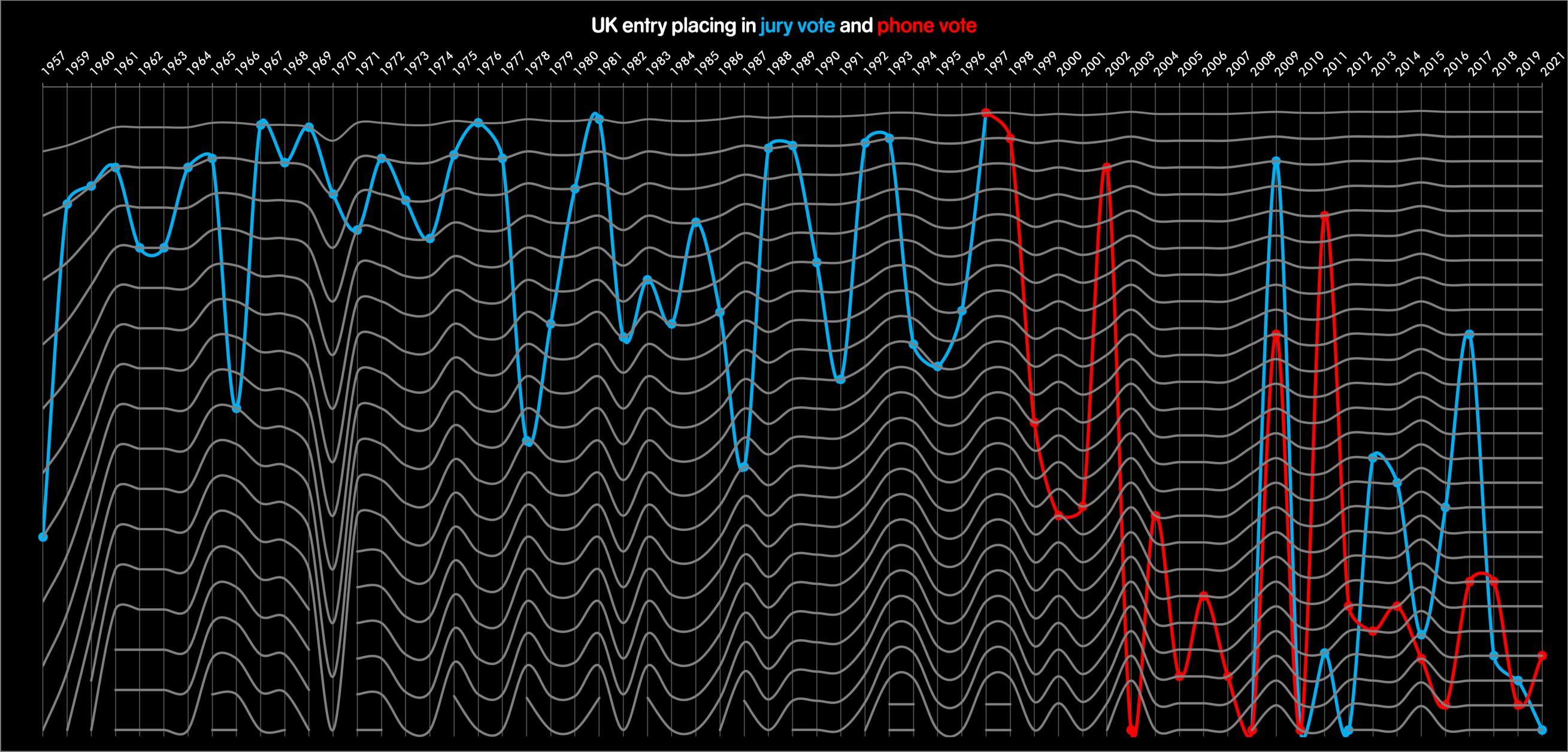
The graph above shows the UK's
placing in every contest it's entered, and you can see that, despite
the Jemini blip (and a contrasting high for Jessica Garlick's classy
"Come Back" the previous year), the British demise was a gradual
affair. One might blame it on a lack of self belief, or perhaps on a
growing dissatisfaction amongst the electorate with the attitude of the
handwringing and self-pitying British machine. Whatever the exact
cause, 2009 marked a threshold: it was terribly important to the UK
that they do well, and one may also make the argument that the rest of
Europe didn't want to piss the UK off too
much either, lest they take their ball home. The UK still did a talent
show selection, but they got a name in to do the writing (Andrew Lloyd
Webber, to be precise). And it paid off. "Great", someone at the BBC
said; "that worked! Let's do it again but cheaper!" So they got Stock
and Waterman (and the bloke who's replaced Aitken) and they wrote
something that wasn't good enough to be a Jason Donovan B-side, and it
came last again.
In 2011, Blue, an old boyband with some cross-Europe form, were hired for the job. It was a rubbish performance, but their moderate fame seems to have carried them through to 11th, and these days that's a good showing for Britain. The same approach did not, however, work for Engelbert Humperdinck who had the misfortune of going first and not being in particularly fine voice. He came second from bottom. Since then, the UK has failed to break into the teens. So is it that Europe hates them or is it that the UK is just not trying?
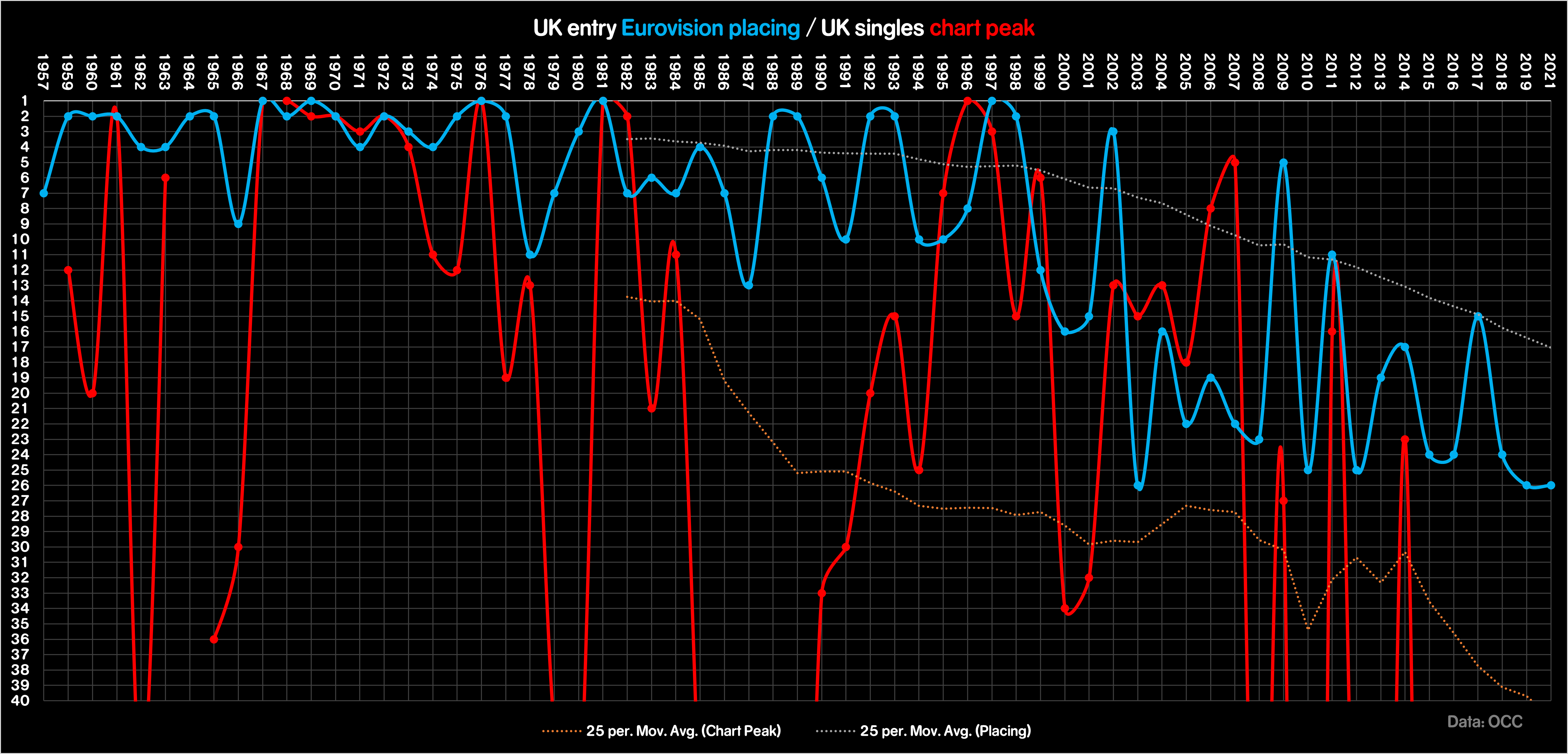
We have a system of testing whether a song is any good or not: it's called the UK singles chart, and the above graph pitches it against Eurovision. It tells an interesting story: for one thing, the post-Iraq lull in the contest is contrasted by top-20 performances in the UK charts. So maybe they were being hard-done-to. More recently, though, the UK is showing a level of disinterest for its contestants not seen since the dark days of the 1980s. And that's just the UK. It's a well trod argument that the UK might do a hell of a lot better in Eurovision if it put some effort into promoting its entries across the continent. As it is, they're not even getting noticed at their own side of the channel.
What can the UK learn from the last couple of decades? That Europe expects more from the UK than a nobody, a shit song and a poor performance. It expects them to put some effort in. Britain has a free pass to the final and should not use that as an excuse to piss about.
If the UK feels hard-done-to in this set-up, it should consider Norway's recent zig-zag of form (winner in 2009, DNQ in 2011, last in 2012, and various parts of the table ever since), or Germany's extremes (last in 2005, first in 2010, currently the UK's main opposition in the battle for last place). Britain is not alone in its erratic results, although the up-down-up-down is distinctively its own. The UK has regained its bounce, it seems.
In 2011, Blue, an old boyband with some cross-Europe form, were hired for the job. It was a rubbish performance, but their moderate fame seems to have carried them through to 11th, and these days that's a good showing for Britain. The same approach did not, however, work for Engelbert Humperdinck who had the misfortune of going first and not being in particularly fine voice. He came second from bottom. Since then, the UK has failed to break into the teens. So is it that Europe hates them or is it that the UK is just not trying?
We have a system of testing whether a song is any good or not: it's called the UK singles chart, and the above graph pitches it against Eurovision. It tells an interesting story: for one thing, the post-Iraq lull in the contest is contrasted by top-20 performances in the UK charts. So maybe they were being hard-done-to. More recently, though, the UK is showing a level of disinterest for its contestants not seen since the dark days of the 1980s. And that's just the UK. It's a well trod argument that the UK might do a hell of a lot better in Eurovision if it put some effort into promoting its entries across the continent. As it is, they're not even getting noticed at their own side of the channel.
What can the UK learn from the last couple of decades? That Europe expects more from the UK than a nobody, a shit song and a poor performance. It expects them to put some effort in. Britain has a free pass to the final and should not use that as an excuse to piss about.
If the UK feels hard-done-to in this set-up, it should consider Norway's recent zig-zag of form (winner in 2009, DNQ in 2011, last in 2012, and various parts of the table ever since), or Germany's extremes (last in 2005, first in 2010, currently the UK's main opposition in the battle for last place). Britain is not alone in its erratic results, although the up-down-up-down is distinctively its own. The UK has regained its bounce, it seems.
Here, then, are the votings of the AView jury:
|
1pt |
1971 |
AV:
6th Eur: 4th |
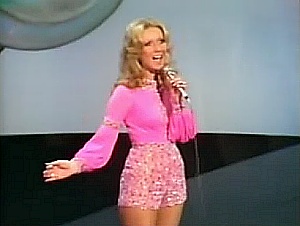
| Clodagh Rodgers - "Jack in the Box" | |||
|
Terry Jones scrubs up well as
the Belfast Lulu selected by the UK to perform in Ireland at a time
when such things elicited death threats. She doesn't seem to have let
that bother her, and delivers a splendid piece of cabaret fun while
wearing pink spangly hotpants.
|
|||

|
2pts |
1984 | AV:
5th Eur: 7th |
| Belle & the Devotions - "Love Games" | |||
|
The UK seemingly embraced its
Danelaw heritage by entering something genuinely a bit weird and
interesting: Belle & The Devotions were a curious girl-group cross
between Vivienne Westwood, Marina from Last of the Summer Wine, and some
kind of alien jellyfish. Dressed in fluorescent greens and yellows
theirs was a most un-British entry: the Supremes taking it both ways.
Curiously they made a big thing of taking off their jackets (presumably
they missed 1981), which seems an odd gimmick. It's a slightly
shambolic but somewhat endearing performance and it's hard to go too
wrong doing the Supremes. The punky look is a curious contrast to such
an emphatically girl-group sound and performance.
|
|||
|
3pts |
1983 | AV:
8th Eur: 6th |
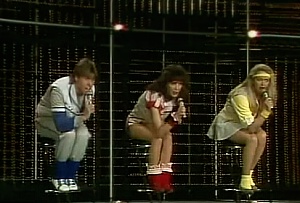
| Sweet Dreams - "I'm Never Giving Up" | |||
|
Mummy, what were the '80s like?
Sweet Dreams' mummy is Olivia Newton John. This trio of keep-fitters
have met after squash for an orange-juice in the bar. But they're very
fidgety on their bar-stools, dancing around them, standing on them, and
even knocking them over. It's a tremendously slick performance, and
both the song and its delivery foreshadow next year's winner "Diggi-Loo
Diggi-Ley", providing the missing link between Bucks Fizz and Herreys.
|
|||
|
4pts |
1959 | AV:
2nd Eur: 2nd |
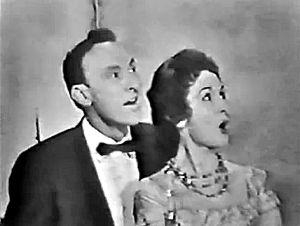
| Pearl Carr & Teddy Johnson - "Sing, Little Birdie" | |||
|
Mao's favourite is all whistles
and wide-eyed jaunt. Teddy has more than a little of the Monkhouse
about him, and the pair of them over-act enthusiastically like a pair
of children's television presenters or patronising care workers.
Fortunately, the song is fun enough for us to be carried along with it.
|
|||
|
5pts |
2003 | AV:
7th Eur: 26th |
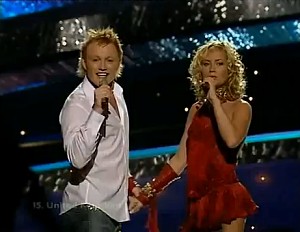
| Jemini - "Cry Baby" | |||
|
As a tonal exercise Jemini's
performance is a masterpiece: if not Stravinsky then at least Satie.
Either they have a real talent or the Latvian sound engineer does. It's
amazingly well done. Alas, Europe has little taste for discordant
harmony so Jemini's ability to consistently sing a semi-tone away from
the backing track was not given the appreciation it deserved. One has
to feel sorry for them really. From the first line one can see concern
in the eyes of Gemma, the female half of the duo. One suspects that had
they done a Spain and acted confused, what was reportedly a monitor
problem (possibly Iraq-related sabotage) would've been fixed and the
song could've started again. Alas, they're well-drilled Professionals:
the Show had to Go On! There's consequently something fascinatingly
Pavlovian in the performance.
|
|||

|
6pts |
1965 | AV:
3rd Eur: 2nd |
| Kathy Kirby - "I Belong" | |||
|
All bubbly joy, eyelashes and
lipgloss, the feisty Kirby delivers this affirmative gay anthem. She
belongs, she belongs she belongs! Stick a big beat under it and you've
almost got Gina G, albeit thirty years earlier.
|
|||
|
7pts |
1981 | AV:
5th Eur: 1st |
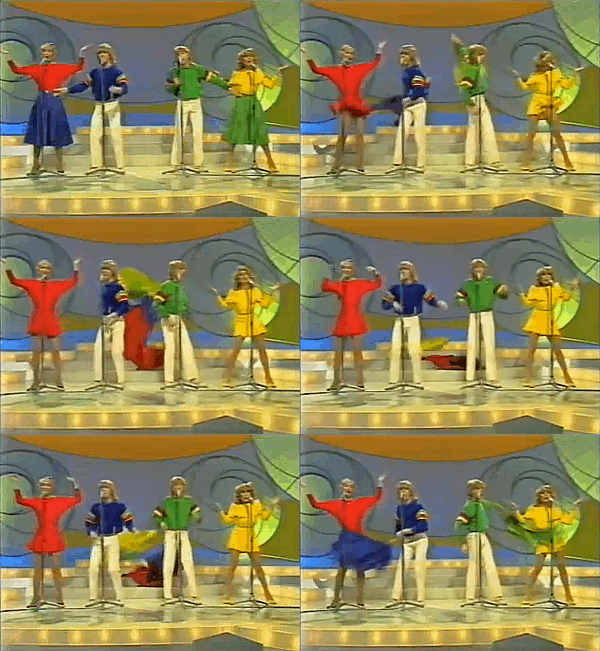
| Bucks Fizz - "Making Your Mind Up" | |||
|
1981 is almost entirely notable
solely for some men from the UK ripping off the skirts of some women
from the UK. After three years of cape removal in the contest it was
the inevitable next stage. "Making Your Mind Up" is a slick piece of
post-Grease '50s-retro bubblegum pop. Perhaps most surprising is how
stiff some of the performance feels; even the stripping. But it was a
good idea: the key change transposed to costume. The song motors along
from the off, and seems to have been perfectly distilled: there is no
flab (there isn't even a verse to speak of). It shouldn't be hard to
manage that in a three minute song, and yet it happens so rarely in the
contest. A worthy winner then.
|
|||

|
8pts |
1996 | AV:
2nd Eur: 8th |
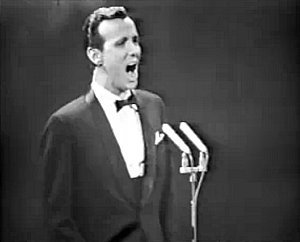
| Gina G - "Ooh Aah... Just a Little Bit" | |||
|
The UK's best entry in a long
time is a dizzy club anthem that "goes big in the hall". Gina G and her
backing dancers bear more than a passing resemblance to the Spice
Girls, though the similarity is coincidental: "Wannabe" was released
only three weeks later. This is an energetic (if occasionally off-key)
performance, and there are prop computers on stage, demonstrating that
we have entered a new era of music, and a new era of Eurovision. One
might legitimately see this song as the first significant salvo against
the bodhráns of the Irish supremacy. In such a way "Ooh Aah..."
represents our salvation: the purging of the pipes.
|
|||
|
10pts |
1960 | AV:
1st Eur: 2nd |
| Bryan Johnson - "Looking High, High, High" | |||
|
A year after Pearl Carr and
Teddy Johnson, we're joined by Teddy's brother Bryan. Cleese-ish and
stiff of arm, he whistled with gusto and knocked us all down with the
proverbial feather with a fantastic song: a martially inflected jaunt
across land and sea in search of the absconded love of his life,
accompanied all the way by multi-consonantal rhymes (dearly /
sincerely; devotion / notion...) and his fine whistling. In our minds
this was the second victory for the United Kingdom and marked their
unmistakable arrival alongside Germany as a truly Great Power in
Eurovision. We placed it 9th in our all-time Top 10.
|
|||

|
12pts |
2006 | AV:
1st Eur: 19th |
| Daz Sampson - "Teenage Life" | |||
|
A chorus of Eliza Doolittle
-vowelled naughty schoolgirls introduce the 2006 UK entry from a-perch
their desks. Police sirens in the background alert us to the
probability of an approaching felon, and here he is, hiding behind the
blackboard. Yes, it's Daz Samspon, a sort of cross between Mark
Radcliffe, John Barnes and a 40-something Polish builder. He's amazing:
his stationary feet a feat to admire. The template for this performance
is, one assumes, something along the lines of The Streets. But it is
one part Streets to three parts Grange Hill to eight parts Changing
Rooms: the juxtaposition of local handyman and mature school-girl
chorus (impressively deployed throughout, a la Oliver!) is
jaw-droppingly entertaining. It makes one oddly proud that such a thing
(co-written by a Cuban Boy) could win A Song for Europe. "Vote for the
music", says Daz at the end, alert to the politics of recent years.
Well, we'll take the performance into consideration too, Daz, but even
then you get our 12pts.
|
|||