| R.B.4 1 A V I E W 2 0 0
7 / 8 |
 |
1
IM 448199 |
| R.B.4 1 A V I E W 2 0 0
7 / 8 |
|
1
IM 448199 |
| An important aspect of
digital picture
quality is resolution. The lower the resolution, the lesser the detail.
Let's put some pixels on the rack and see what's going on in the modern
world of frame transmission.
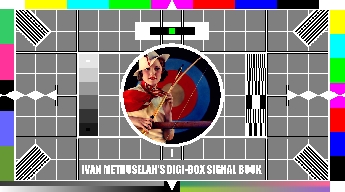
To start with, I took
our lovely new testcard starring former 'Ziegfeld Folly' Dorothy Flood
in the role of Carole Hersee.
A reduction of the image in question is provided, right, but in reality
it is 1440x1080 pixels (HD size). For this experiment it will be
reduced to various resolutions of 576 in the vertical to mimic the
resolutions of digital television. That's still quite a lot of picture
for a little page like this so for ease of reference we're going to use
crops. But clicking on a crop will bring up the full testcard for that
resolution should you wish to enjoy the simulations in their full
splendour (worth it in most cases for the frequency gratings alone). |
 |
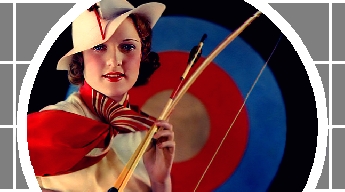 |
At
a straight
resolution of 1024x576, the image looks like the one on the left.
There's a little distortion due to the reduction from 1440x1080 but
it's barely noticable.
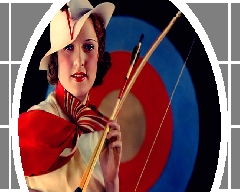
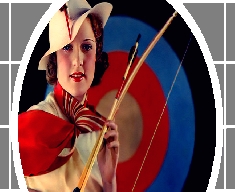
The QAM-16 multiplexes broadcast their channels in a DVD-standard PAL resolution of 720x576. When the picture is glued together again, the pixels are stretched, and what results is given right. I1 and C4 use a slightly lower 704x576 resolution. The centre-left crop is a mock-up of this. Most of the QAM-64 channels go with a paltry 544x576. This is not quite a halving of the screen-width in 16:9, and the results are centre-right. This 544 resolution is still theoretically better than an analogue PAL broadcast which is estimated as equivalent to about 440x576 (bottom-left). And then there's VHS,
which is
given to be about 330x576 (bottom-right). I have to say that this
simulation
looks a lot crummier than most of my video collection, but you get the
idea. |
 |
 |
 |
|
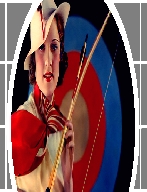 |
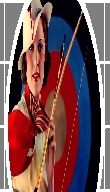 |
To counteract the blockiness,
broadcasters employ the digital equivalent of smearing vaseline over
the lens: "anti-aliasing", in which pixels are blurred for a smoother
image. This leads to a loss of definition but makes the reduced picture
look a lot less like a
computer game:
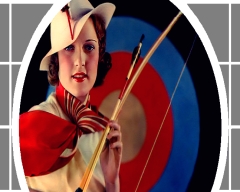 720x576 anti-aliased |
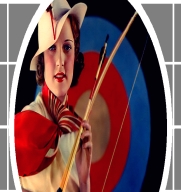 544x576 anti-aliased |
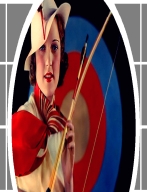 440x576 anti-aliased (≈PAL) |
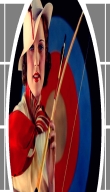 330x576 anti-aliased (≈VHS) |