| R.B.4 1 A V I E W 2 0 0
7 / 8 |
 |
1
IM 448199 |
| R.B.4 1 A V I E W 2 0 0
7 / 8 |
|
1
IM 448199 |
|
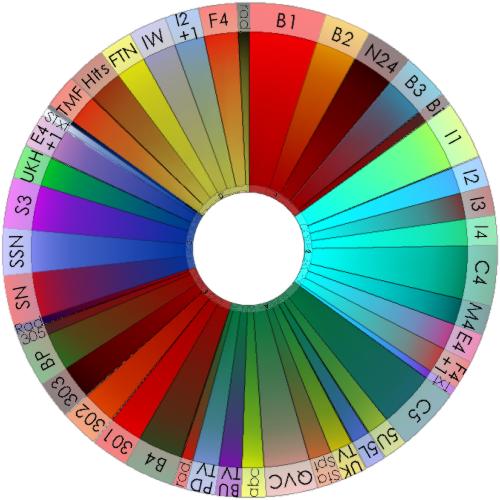
4: BITRATES On the right here is a
rather
pretty little colour wheel. It represents the breakdown of the digital
TV spectrum. Channels are shown in their multiplex blocks (clockwise: 1, 2, A, B, C, D).
It should be noted that with the exception of B1, I1 and C4, the
bitrate
allocated to each channel is variable within the confines of its
multiplex.
If something image-intense like sport is being shown on, say, I2, then
I3 and I4 will go to a higher compression (and hence a lower bitrate)
to
relieve any blocking on I2's football pitch. Still, any viewer of
Doctor
Who's Tardis control room can see that even B1's 4½ megabits per
second
can go all blotchy with two much red or cyan on the screen, much like
the
compressed JPEG that is our diagram. Such are the limitations of
Freeview's
MPEG-2 compression format, especially when there's atmospherics to
contend
with. |
A
relative
bitrate bandwidth per channel
|
|
|
MUX. | AVERAGE BITRATE |
SHARE |
AUDIO BITRATE |
(x576) |
MAX GOP |
|
|
|
1 |
4500 | 1 | 256 |
|
12 |
|
|
CBeebies (0600-1900) |
B | 3250 |
1/5 | 256 |
|
18 |
|
|
|
1 | 3250 |
1/3 | 256 |
|
12 |
|
|
CBBC (0700-1900) |
1 | 3250 |
1/3 | 256 |
|
12 |
|
|
|
1 | 3250 |
1/3 | 192 |
|
12 |
|
|
|
2 |
3000 |
1/4 | 192 |
|
12 |
|
|
|
C |
2750 |
1/3 | 192 |
|
18 |
|
|
|
C | 2750 |
1/3 | 192 |
|
18 |
|
|
|
C | 2750 |
1/3 | 192 |
|
18 |
|
|
Smile TV (0300-0700) |
C | 2750 |
1/2 | 192 |
|
18 |
|
|
|
2 | 2750 |
1/4 | 192 |
|
12 |
|
|
|
B |
2750 |
1/5 | 192/128 |
|
18 |
|
|
|
D |
2500 | 1/6 | 192 |
|
40+ |
|
|
|
D | 2500 |
1/6 | 160 |
|
40+ |
|
|
|
A |
2500 |
1/5 | 192 |
|
12 |
|
|
Community Channel (0600-0900) |
B | 2500 | 1/5 | 192/128 |
|
18 |
|
|
|
D | 2250 | 1/6 | 192 |
|
40+ |
|
|
|
C | 2250 | 1/2 | 192 |
|
18 |
|
|
|
2 | 2250 | 1/4 | 192 |
|
12 |
|
|
|
2 | 2250 | 1/4 | 192 |
|
12 |
|
|
|
D | 2000 | 1/6 | 192 |
|
40+ |
|
|
UKTV History (0700-1800) |
D | 2000 | 1/6 | 192 |
|
40+ |
|
|
National Lottery Xtra (0845-0945) Gems TV (0945-1245) |
D | 2000 | 1/6 | 160 |
|
40+ |
|
|
|
A | 2000 | 1/4 | 128 |
|
40+ |
|
|
|
A | 2000 | 1/4 | 128 |
|
40+ |
|
|
Gems TV 1 (1900-2100) Nuts TV (2100-0100) Top Up TV Anytime 2 (0100-0600) |
A | 2000 | 1/4 | 128 |
|
40+ |
|
|
|
A | 2000 | 1/5 | 128 |
|
40+ |
|
|
Television X (2300-0400) |
A | 2000 | 1/5 | 128 |
|
40+ |
|
|
Top Up TV Anytime 1 (0300-1200) |
A | 2000 | 1/5 | 128 |
|
40+ |
|
|
|
2 | 2000 | 1/4 | 192 |
|
12 |
|
|
|
2 | 2000 |
1/4 | 192 |
|
12 |
|
|
|
2 | 2000 | 1/4 | 192 |
|
12 |
|
|
|
2 | 2000 | 1/4 | 192 |
|
12 |
|
|
|
A | 1750 | 1/4 | 128 |
|
40+ |
|
|
UKTV G.O.L.D. (1800-2330) Top Up TV Anytime 3 (2330-1300) UKTV Style (1400-1600) |
A | 1750 | 1/5 | 128 |
|
40+ |
|
|
|
B | 1750 | 1/5 | 128 |
|
18 |
|
In the above table the channels are listed in approximate order of their average bitrate (given in kbit/s to the nearest 250). The greater the bitrate, the lesser the image compression and hence the better the picture. In simple terms, a lower bitrate is achieved by extending the GOP length or by reducing the reference i-frame's image quality as one might when compressing a JPEG. It's worthwhile knowing that 5000 kbit/s is the DVD-standard bitrate (maxing out at 8000). 1000 would be roughly equivalent to VHS while HD is 15000.
It should be born in mind that the bitrates listed are an average and that the actual bitrate is variable: if a channel is showing something particularly graphically intense its bitrate will increase; if it is showing a black screen its bitrate will be tiny. Taking that information on board, BBC 1 can be seen to broadcast pretty much at DVD quality.
The coloured panels in the
table show "statistical multiplexes", that is to say
groups of 'bandwidth buddies'. These are channels which share / fight
for an
allocated
section
of bandwidth within their multiplex. I1, C4, C5 and B4 get to take two
slices
or so of cake in such battles. B1 is now the only channel to not
partake in such statistical multiplexing (apparently a legacy of its
regional variations set-up and the low technology of Mux1) but it
intends to tie up with its fellow Mux1 channels at the turn of 2009.
The column labeled "SHARE" indicates the degree of bandwidth
competition for each channel (and should also help give an idea as to
the maximum bandwidth available): "1/4", for instance, indicates that
the
channel is one of a group of four such bandwidth buddies.
An interesting observation to
make here concerns
E4+1 and ITV2+1. Most significantly, both are broadcast at a higher
resolution than their live counterparts, meaning that all other factors
being equal the timeshift stream should provide the superior picture.
The live channels do use lower maximum GOP lengths, but given that the
live and timeshift channels have the same average bitrate, the i-frame
compression of the live channel is likely to be greater. The usual
caveats of course apply here: factoring in the temporal dimension, the
longer GOPs of the +1 channels will present their own problems, but GOP
lengths need not be at their maximum extent. Given busy movement in
footage, the +1 channels can shorten their GOPs resulting in a picture
compression factor equal to (or, if we wanted the same GOP length and
bitrate, slightly greater than) that of the live channels. But still
the +1s would have the advantage of a higher broadcast resolution. The reason for such an unusual
discrepancy is simply an accident of history. The later slots (those
taken by the +1s) just happened to
be a bit roomier than the originals. It's perhaps worth pointing out
that the bitrate difference between a 720 res i-frame over an 18 long
GOP and a 544 res i-frame of equal compression over a 12 long GOP is
only about 100kbit/s, so the higher resolution of E4+1 really is worth
considering, especially for any episode of Friends where Chandler is
comatose (and hence not causing the GOP maths too much difficulty with
his flailing arms).