| In
the beginning there was a very large, very early computer that took up
a small room in one of the Maths blocks. You had to book time on it and
couldn't overrun as someone else would be waiting for their turn. Then
came a shaft of light in the form of the BBC Micro, and later the Master.
You could run a laser-disc off one of them... the Domesday Disc, for instance...
that was great... Multimap crossed with an encyclopaedia. Back in the days
before the internet, that was really rather special. We had it at Anston
Park Junior School. The photo for Dinnington was of the old bus-stop in
front of the church, where that odd round thing is now. Apparently all
the Domesday Discs rotted away and are unreadable now. Unlike the book
on which it was based...
There
was nothing nearly so high-tech at DCS though...
Certainly, the school had some sort of menu program in operation, from which you would select the program you wanted. Principal among these were: EDWORD - The standard word processor. Blue and black thing, with white text. Imagine a more colourful Notepad but with a character readout. Edword was the domain of the English Dept. LOGO - Most of your time at a BBC would be spent operating this geometric programming language thingy. Beloved of both Maths and IT, the Maths Annexe page shows a simple program and its results. For the uninitiated, LOGO was essentially computer etch-a-sketch, with added turtles (and a PEN UP command). If you sift through Google, you should be able to find a PC version. The pinnacle of achievement would be to draw a house. More typically, you'd end up with a spyrographical mess. FOLIO - Not sure there was much use for this at DCS, but it's worth a mention... If memory serves, this was something mid-way between a desk-top publisher and a set of fonts. Back in those days, the only typefaces available were what your printer could kick out. Folio gave you the power to make huge great big words in pretty styles. That was about it... Not bad for the days when computer snooker required one of the balls to flash because of the palette size. Then there were the subject specialist programs... but I've already written about them here. |
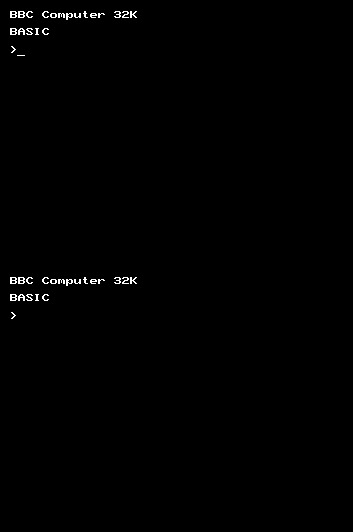 The BBCs found their way into schools in the early/mid-1980s, and were located in a dedicated computer-room in the middle of Lower School. The maths annexe also had a handful... I remember one being in the back cupboard of Mrs Randall's room. It was used for Logo. English classes would book the computer room for word processing sessions. Later, IT classrooms grew up, some holding BBCs (and maybe the odd stray Archimedes). These rooms were scattered through lower school, with one errant batch stuck up in Hatfield. To emulate a BBC on a PC, there are a few options... The prettiest is probably BeebEm, which runs in a DOS box. But it struggles slightly with Elite A, and frankly, a BBC emulator that can't do Elite A (a funked up reworking of Elite) is slightly missing the point. So in such circumstances there's Beeb in C, which isn't nearly so pretty, but just about does the trick. Saying that, though, I haven't actually played Elite A, because I'm finding it a bit ugly (I've got used to the old PC version), and I keep getting killed... In the end, your choice of an emulator depends a lot on what you intend to run on it, and to be honest, there's not a lot that you'd want to run that you can't run by other means... There's a PC Chuckie Egg out there after all... Didn't
DCS have a personalised header on the start-screen? You could add a second
row, I think, and I'm pretty sure that DCS did. But I might be wrong.
|
|
By the early 1990s, the days of the BBC were numbered... It's flashier cousin, the Archimedes was already sneaking in on the periphery, on account of a voucher scheme at Tescos... While the BBC was pretty much the head of its class, the Archimedes was a slightly different matter. Spec-wise, it wasn't a hell of a lot different to the Atari and Amiga, and they had the added bonus of a damn site more software, but the Archimedes DID have the bonus of backwards compatibility, and (more importantly) cheapness. But as the '90s wore on, and the PC started to come to the fore, there was certainly a sense that Tescos were lumbering schools with second best. That said, the Archimedes had some positives... particularly the way you could reallocate memory on the fly... that was fun... And the way that with the click of a mouse it could turn into a BBC. But it had some silly things too, most memorably the three-button mouse, which to be honest was a bit over-the-top for what you could do with it. Better three than the one button you got with an Apple, but the two buttons of the 16-bit home-computers were really perfectly adequate. As
far as software was concerned, there was a somewhat standard selection:
some word-processor or other, and, I think, the graphics program Artisan
(pretty-much equivalent in spec to Deluxe Paint and Degas Elite), which
I seem to remember using in technology, though it may just have been the
default (and slightly painful) Paint program. Most importantly though,
there was a Teletext browser... Again, in the days before the internet
came to our humble little lives, having teletext on a computer was a diverting
form of entertainment. Diploma Foundation lessons were largely spent on
this (rather than doing work). The trouble was that there was only so much
bandwidth going on, and so while it was possible for one person to play
Bambooze, once the entire class got hold of the idea the system would grind
to a halt.
|
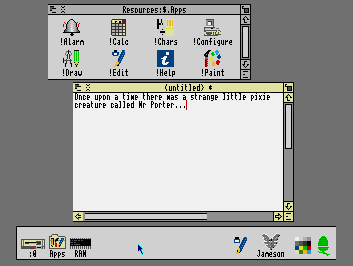 In the games market there were one or two Archimedes-only games, and the odd port. The technology department had Lemmings, which kept Mr Corbridge very busy... The Archimedes version of Elite is very highly rated, although I find it unplayable because I grew up on keyboard recentering, and Arch Elite doesn't seem to have it. Ah well... As far as emulation goes, "Archie" seems to do the trick without putting a hole in your pocket. By 1996, the Archimedes had just about replaced the BBC at DCS, just in time for the lot of them to effectively be wiped out by the fire. This was good timing really, considering the rise and rise of the IBM PC... |
|
Then there were the niche machines... Music had an Atari ST, because STs were cheap and had a MIDI port as standard. But as far as I know, the only software that ever got run on it was the music manager game: "Rock Star Ate My Hamster". English and Media Studies opted for DTP favourite, the Apple Mac. History shared English's Macs, presumably due to the fact that the two departments practically lived on top of each other (Terrapin Plateau and Segrave Kitchens). Funny little things, Macs. Far too over-simplified. The computer and monitor are one single entity (with a separate keyboard), the monitor screen itself being a tiny, murky, grey, postage-stamp-sized thing. And the mouse only had one button, which suggested "remedial" really. The Mac came across as a highly patronising machine, strictly for use by stupid people. I mean, the disk-drive didn't even have an eject button! You had to select "eject" from a menu. So you were buggered if there was a power-cut, or your machine crashed. You had to jam a bit of metal in a little hole or summat. Madness. Oversimplification to the point where using the machine actually becomes more complicated and awkward. Hateful things really. Bit of a backwards step from the Archimedes. Media studies had a few of these crusty old Macs, and a couple of Mac IIs. These were a damn site better really. Much closer to a proper computer: separate (and decent sized) monitor... colour screen... Might even've had eject buttons. There may also have been a couple of Classics (like the old Macs but with a colour postage-stamp). These were second in the pecking order, behind the Mac IIs but ahead of the Mac Is. And
then there was the Power Mac... The closest thing yet to a proper PC. It
had a CD ROM, which habitually ran Cinemania (a CD equivalent of IMDb,
effectively). Back then, Cinemania was the new Domesday Disc to us; another
great leap forward; another exciting piece of technology. The Domesday
Disc showed photos of Dinnington... Cinemania played clips of Star Wars!
Although we tended instead to look up the photo of Craig T. Nelson, for
reasons too pathetic to dwell on.
|
 Of course, now we have the internet; and Cinemania, like the Domesday Disc before it, has become just another useless frisbee... Back then, in the mid-'90s, the internet was something you just heard rumours about... The first PCs to enter DCS belonged to the revamped technology department, who'd built a fancy little room especially for them. I seem to remember using some sort of graphics program there. It was a special place. By 1995, one of the Lower School computer rooms had PCs in it, because I remember having a Maths lesson there where we had to use spreadsheets. Presumably these all turned into smouldering mounds of plastic after the fire. So in ten years, DCS had made it through three eras of computing, and I was there to play on them all. It makes me feel a bit old. If that's not bad enough, I can remember LED calculators... Maybe I'll write about them another time... At least slide-rules were obsolete by the time I came along. |