| And so, by way of answer to all
those people who said 'Old Europe' could never win again, we find
ourselves in Norway. Denmark's song proved strangely memorable, though that may be because déjà vu is twined through its DNA. The verse has been shown a copy of "Every Breath You Take", probably by the male vocalist who has turned up dressed like Sting. He and his duet partner sing from different sides of a translucent white screen, harking back to a similar gimmick in Ukraine's 2008 performance. Later they find themselves on travellators, having seen Greece last year. The anthemic chorus is also oddly familiar, though quite what the tributary is we've yet to finger. It's certainly amazing in a "my god, it's like the '90s never happened" kind of way. Another duet that harks back somewhat is that of Romania. Visually theirs is a recreation of the UK's 1977 entry "Rock Bottom", albeit revised for the perspex generation. Our two singers face off either-side of a double-ended, LED-lit transparent plastic piano, the keys of which glow red when depressed. It's a very '80s performance (or '90s in Eurovision terms), with a chorus to match. The verse is a sassier affair, expressively delivered over a playful bass-line. Imagine Bis's "Kandy Pop" given an AOR production and being performed by Billy Joel and Shania Twain and one might not be a million miles from the truth (though one would also require a dangerously vivid imagination). At the three-quarter mark we're treated to a spot of operatic bombast (and a sort of "Lapponia" tribute) just to tick all the boxes, then finally, after lots of promising leg-wiggling by the female party, our two vocalists rise from their perspex piano and take to the floor to deliver their last chorus. With a Rachel Stevens bassline, Sarfraz Manzoor and Mark Benton's love-child on an electric fiddle, and three black backing vocalists, Albania give us an old-school dance-floor pounder that somewhat resembles the Siegel-penned German entry "Let's Get Happy" from 2003, albeit not as good. Greece, on the other hand, took inspiration from last year's Ukrainian entry. They are sexy hairy bum bum. Or shaved... perhaps shaved. They're certainly very Greek, in every way one can conceive. The rave-folk chorus owes less to Svetlana than the profoundly grunty verse. The whole thing sweats testosterone. There's a break in play three quarters in, with some light-box drums armed with fireworks. It helps keep things interesting in what for us was the best song of the night. Perhaps inspired by Norway's "Fairytale" win last year, Spain raided the toy-box for a jaunty carousel waltz of the sort that used to go down well with the Alpine block in the old days. They got to play it twice thanks to a fairly innocuous stage invasion (a serial publicity-seeker joining in with the dancers and flustering nobody before being ushered away). A second invasion in the form of a second singer helps move the carousel up a gear for a well-deserved big finish. Strumming at guitars this year were Russia, who donned nice thick jumpers and scarves and went out in the snow, all Aled Jones -like, for a beautiful piece of melancholia. A great crane-shot between two audience monitors seems to recall the Quantel days and this triggers a well of nostalgia that explodes like freshly tapped oil and resonates through the soaring "woah" that opens up the tear-jerking lighter-waving chorus. "What are you doing?" asks the guitarist during a partially spoken verse two. "I'm looking at her photo," replies the haunted vocalist, clutching a crumpled line-drawing. The guitarist suggests he burns the item; "oh yes, yes I've got to burn her now, cos I have to forget her now"... It's rather moving, and the more the snow falls, the more the piece begins to take on the mood of some Russian novel. The wind machine kicks in and our Master begins to yodel at his Margarita through the rousing chorus before casting her adrift on the wind. It's all really very beautiful... The winner on the night was the German entry, Lena. Hers is a sassy, skittish little ditty, modern in a timeless sort of way. It owes something to Lilly Allen or Kate Nash and something else to Latvia's ground-breaking (in Eurovision terms) 2000 entry; not least in terms of her accent which is decidedly wide and Björkish, if Björk were from Bristol; one might describe it as West Saxon were one feeling playful. It is simply presented: some backing vocalists hidden in the background and a woman in a little black dress twitching un-choreographed at centre-stage. It lends it an effortless charm which doubtless helped it along. For each year's songs we apply our points in the 12-10-8 style of the modern contest, irrespective of how the voting functioned at the time. In brackets is the position the song came on the night:
Europe had Turkey second, Azerbaijan fifth, Belgium sixth, Georgia ninth, Ukraine tenth, Russia eleventh, Serbia 13th, Israel 14th, Bosnia & Herzegovina 17th, Portugal 18th, Norway 20th, Cyprus 21st, Moldova 22nd, Ireland 23rd and Belarus 24th. The UK came last having been out SAWed by at least two other acts. |
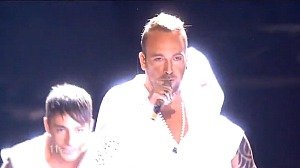 Our winners: Dirty, filthy Greece.  To fend off the cold, Peter Nalitch contemplates burning his girlfriend.  Europe's winner: Lena. Her underwear matches the lighting. 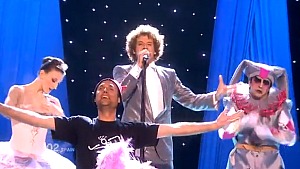 Spain's Daniel Diges and friends.  Albania's Juliana Pasha in her Dschinghis Khan jerkin.  Denmark disavow the last decade. 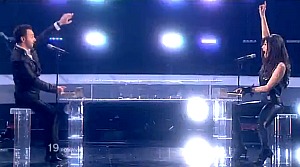 Romania hit Rock Bottom.
To see our original thoughts, recorded on the night of the contest, click here. |


