| To Mother Russia, then, for a
good kicking ahead of an evening of high camp. Leading the stakes in
that regard were ever-macho Greece: Eurovision veteran Sakis Rouvas
riding atop a travellator and gyrating to the first song of the night
that's really any good: a relentlessly uplifting club anthem. "This is
our night", he tells us through his head-set mic. He's wrong, but it's
not a bad effort all the same. The travellator stuff is great,
especially at the end when it opens up, stapler-like, raising our
singer and revealing the Greek flag beneath. Despite a Nirvana-ish start, Turkey's entry, "Düm Tek Tek" proved a reversion to their "type A" formula: a red-clad belly-dancer doing a harem-girl take on modern up-beat 'R&B'. It's all pleasantly feisty: a twitchy little verse and matching chorus joined at the hip by an out-of-control escalator of a bridge. Moldova took the trad-folk/skronk route, like Leningrad Cowboys but with less humour. It's all very shouty and dancy, as one might hope, and is delivered by a sort of national dress version of Gina G. It makes you wonder if perhaps the only way the UK might win again would be to do a rave-beat morris-dance. Also in national dress were Armenia, outfitted like extras from a Paradjanov film while writhing sensually on a dais to a pleasingly slinky number with a punchy bassline. "Everybody move your body", they suggest, like some medieval Zager Band. It's hard not to follow their advice. An entertaining change section in the middle adds a kick of eastern charm to proceedings in what is a rather fetching performance. "You are sexy bum bum", Svetlana seems to say as she gyrates around her giant hamster-wheel climbing-frames surrounded by bare-chested Roman legionaries. As a spectacle this takes some beating: as the grimy bass-line and ethnically-tinged brass flourishes of the verse give way to the pounding, tit-wiggling flaunt of the chorus, so our intrepid vocalist gets hurled about by her loyal troops and shakes her stuff most impressively. At one point she even takes to the drums, on a kit that is being hauled across stage by her soldiers. As Laibach-esque pistons pump up and down on the video-walls it becomes apparent that this is one of the greatest performances Eurovision has ever seen; and a cracking song to boot: a song that deserves time in the charts and could stand aside anything Britney or Lady Ga-Ga might care to throw our way. A masterpiece with a sexy bum. Europe preferred the retro stylings of Norway: impish pretty-boy fiddler Alexander Rybak with his bouncing "Puppet on a String" knees-up. The backing vocalists are quite amusing; the back-flipping dancers less-so (at one point they pathetically kick some hats that have been suspended on mic-stands). Rybak is either charming or irritating, depending on your tolerance of cheeky winkers, and the same goes for the song. For each year's songs we apply our points in the 12-10-8 style of the modern contest, irrespective of how the voting functioned at the time. In brackets is the position the song came on the night:
Europe voted Norway as their winner, with Iceland second, the UK fifth, Estonia sixth, France eighth, Russia eleventh, Denmark 13th, Portugal 15th, Israel 16th, Albania 17th, Croatia 18th, Romania 19th, Germany 20th, Malta 22nd and Lithuania joint-23rd. |
 One of her cohort admires Svetlana's sexy bum bum. 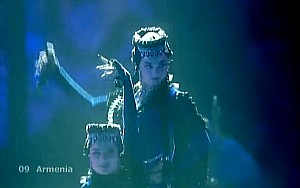 Inga and Anush move their bodies. 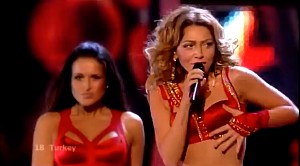 Hadise feels her heart go Düm Tek Tek. 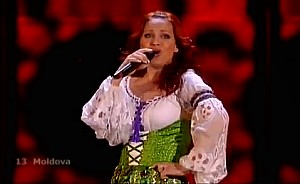 Moldova invite us to their equivalent of a ceilidh.  Sakis Rouvas rides atop his giant stapler. 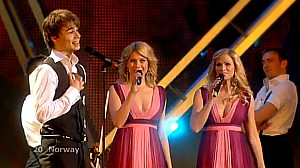 Europe's winner: Norwegian fol-de-troll. |
| POLITICS |
| Telephone
voting being generally considered to be a bit dodgy, national juries
were reintroduced to provide 50% of the vote. Georgia withdrew in protest against the war in South Ossetia. Inspired by its win in the junior contest (including a 12pt award from Russia) it revoked its withdrawal, only to have its chosen song excluded for containing political references. Georgia disputed this, citing pressure from Russia as the real reason for the exclusion (although the entrants themselves admitted a deliberate anti-Putin message), and so withdrew for a second time. Spain got into some trouble (and elicited a wide range of conspiracy theories) for broadcasting their elected semi-final on a tape delay of over an hour. A gay pride event, held in Moscow the day before the final, was somewhat violently broken up by police. The most overt reference to this during the contest appears to have been the Swedish spokesperson's wearing of a rainbow dog-tag; there wasn't exactly a massive demonstration of solidarity. In August 2009, Azerbaijan's Ministry of National Security reportedly questioned a selection of the 43 Azerbaijanis who had voted for the Armenian entry, accusing them of being "unpatriotic" and "a potential security threat". |
Let's now take a snapshot of how the various nations did over the course of the 2000s. For the sake of comparison, the top ten places in the final official standings for each contest are assigned 12-10-8 style points. In the case of a tie for place, the nation that received the highest individual score from a single jury takes the place, and if no resolution is forthcoming from this method then the benefit goes to that nation which our own jury scored the higher. Any ties in the final tally are broken by average performance, and where that is the same they are broken by highest annual placing.
Alongside the '00s snapshot, we'll also
take a look at the running
total since 1957. Change since the '90s tally is given in brackets.
| 2000s
PERFORMANCE |
1957-2009
PERFORMANCE |
|||||||||
| AVIEW
JURY |
EUROPE | AVIEW JURY | EUROPE | |||||||
| 52pts ▲15 |
 SWE |
1 |
 RUS |
49pts ▲27 |
218pts = |
 ESP |
1 |
 GBR |
309pts = |
|
| 49pts NEW |
 UKR |
2 |
 GRE |
46pts ▲19 |
187pts = |
 GER |
2 |
 FRA |
237pts = |
|
| 45pts = |
GRE |
3 |
 TUR |
38pts ▲17 |
188pts = |
 FIN |
3 |
 IRL |
199pts = |
|
| 45pts = |
TUR |
4 |
UKR |
36pts NEW |
150pts ▲8 |
SWE |
4 |
SWE |
181pts ▲1 |
|
| 42pts ▲2 |
ESP |
5 |
 SRB |
31pts NEW |
149pts ▲6 |
TUR |
5 |
GER |
170pts ▼1 |
|
| 40pts ▲20 |
 SLO |
6 |
 EST |
31pts ▲8 |
148pts ▲2 |
GBR |
6 |
 ITA |
144pts = |
|
| 34pts ▲4 |
GBR |
7 |
SWE |
30pts ▼4 |
141pts ▼1 |
 ISR |
7 |
 SUI |
141pts = |
|
| 30pts ▼2 |
 CRO |
8 |
 NOR |
27pts ▼3 |
140pts ▼4 |
 NED |
8 |
 LUX |
133pts = |
|
| 25pts ▲25 |
 BIH |
9 |
 LAT |
26pts NEW |
135pts ▼4 |
 POR |
9 |
ESP |
129pts = |
|
| 22pts ▼2 |
FIN |
10 |
 MLT |
25pts ▼3 |
122pts ▲8 |
GRE |
10 |
ISR |
120pts ▲1 |
|
| 19pts ▼10 |
 CYP |
11 |
 DEN |
23pts ▲5 |
115pts ▼4 |
DEN |
11 |
DEN |
115pts ▲1 |
|
| 17pts NEW |
LAT |
12 |
 ROU |
18pts ▲18 |
114pts ▼2 |
 AUT |
12 |
NED |
115pts ▼2 |
|
| 16pts NEW |
 ARM |
13 |
FRA |
16pts ▼9 |
113pts ▼4 |
 BEL |
13 |
NOR |
110pts ▲2 |
|
| 15pts ▲17 |
MLT |
14 |
ARM |
14pts NEW |
100pts ▲1 |
NOR |
14 |
BEL |
98pts = |
|
| 15pts NEW |
 MDA |
15 |
GBR |
14pts ▼13 |
96pts ▼2 |
SUI |
15 |  MON |
89pts ▼2 |
|
| 14pts ▲2 |
 ISL |
16 |
ISL |
13pts ▼4 |
91pts ▼2 |
LUX |
16 |
AUT |
75pts = |
|
| 14pts = |
RUS |
17 |
BIH |
13pts ▲9 |
90pts ▼1 |
ITA |
17 |
GRE |
72pts ▲4 |
|
| 12pts ▼4 |
GER |
18 |
FIN |
12pts ▲16 |
86pts ▼1 |
 YUG |
18 |
MLT |
59pts = |
|
| 9pts NEW |
 ALB |
19 |
GER |
12pts ▼8 |
85pts = |
FRA |
19 |
YUG |
56pts ▼2 |
|
| 9pts ▼7 |
NOR |
20 |
ESP |
12pts ▼11 |
76pts = |
MON |
20 |
RUS |
51pts ▲11 |
|
| 8pts ▲8 |
 HUN |
21 |
 AZE |
11pts NEW |
75pts ▲1 |
CYP |
21 |
TUR |
48pts ▲6 |
|
| 8pts ▼5 |
FRA |
22 |
CYP |
11pts ▼5 |
59pts ▲1 |
CRO |
22 |
EST |
45pts ▲3 |
|
| 8pts NEW |
AZE |
23 | BEL |
10pts ▲1 |
58pts ▼2 |
IRL |
23 | FIN |
42pts ▼4 |
|
| 7pts NEW |
 BLR |
24 | ISR |
9pts ▼18 |
49pts NEW |
UKR |
24 | CYP |
38pts ▼4 |
|
| 7pts ▼23 |
ISR |
25 |  BUL |
6pts NEW |
45pts ▲6 |
SLO |
25 | UKR |
36pts NEW |
|
| 6pts ▼14 |
AUT |
26 | MDA |
6pts NEW |
37pts ▼2 |
ISL |
26 | ISL |
34pts ▼2 |
|
| 4pts ▲5 |
 LTU |
27 | IRL |
6pts ▼26 |
29pts ▼2 |
RUS |
27 | SRB |
31pts NEW |
|
| 3pts ▼6 |
BEL |
28 | BLR |
5pts NEW |
28pts ▼2 |
MLT |
28 | CRO |
28pts ▼6 |
|
| 2pts NEW |
SRB |
29 | AUT |
5pts ▼2 |
25pts ▲7 |
BIH |
29 | LAT |
26pts NEW |
|
| 1pt NEW |
BUL |
30 | LTU |
5pts ▲1 |
17pts NEW |
LAT |
30 | POR |
25pts ▼7 |
|
| 1pt ▼6 |
EST |
31 | SLO |
4pts ▼8 |
16pts NEW |
ARM |
31 | ROU |
18pts ▲3 |
|
| 1pt ▼5 |
ROU |
32 | ALB |
4pts NEW |
15pts NEW |
MDA |
32 | BIH |
17pts ▼2 |
|
| 0pts NEW |
 GEO |
33 |  POL |
4pts ▼14 |
11pts = |
HUN |
33 | ARM |
14pts NEW |
|
| 0pts ▼14 |
POL |
34 | CRO |
3pts ▼24 |
10pts ▼7 |
POL |
34 | POL |
14pts ▼8 |
|
| 0pts ▼14 |
SUI |
35 | SUI |
3pts ▼20 |
9pts NEW |
ALB |
35 | AZE |
11pts NEW |
|
| 0pts ▼31 |
NED |
36 | HUN |
2pts ▼14 |
8pts NEW |
AZE |
36 | HUN |
9pts ▼8 |
|
| 0pts ▼27 |
POR |
37 | GEO |
0pts NEW |
7pts NEW |
BLR |
37 | SLO |
9pts ▼8 |
|
| 0pts ▼10 |
IRL |
38 | NED |
0pts ▼25 |
7pts ▼10 |
 SVK |
38 | BUL |
6pts NEW |
|
| 0pts ▼16 |
 MKD |
39 | POR |
0pts ▼21 |
6pts ▼10 |
MKD |
39 | MDA |
6pts NEW |
|
| 0pts ▼21 |
DEN |
40 | MKD |
0pts ▼11 |
6pts ▼10 |
EST |
40 | BLR |
5pts NEW |
|
| 5pts ▼9 |
ROU |
41 | LTU |
5pts ▼6 |
||||||
| 4pts ▼7 |
LTU |
42 | ALB |
4pts NEW |
||||||
| 2pts NEW |
SRB |
43 |  MAR |
0pts ▼10 |
||||||
| 1pt NEW |
BUL |
44 | GEO |
0pts NEW |
||||||
| 1pt ▼11 |
MAR |
45 | SVK |
0pts ▼9 |
||||||
| 0pts NEW |
GEO |
46 | MKD |
0pts ▼14 |
||||||
Revolution in Europe has led to a revolution in the decade chart: the top for both ourselves and Europe is a mass of risers and the odd new entry. The highest new entry for both of us is the Ukraine (we gave them four top-three placings, and they only missed points from us in 2005 when they were coasting after their victory in 2004), and we're both impressed with Latvia and Armenia, although we disagree somewhat on the values of Serbia (Serbia & Montenegro is incorporated in the Serbian score; adding the Serbian score to the Yugoslavian does not alter our overall chart). In real life, Russia has clearly had a very good decade, taking the top place in the European 2000s chart. They perform far less excitingly in our tally, though by no means badly. There's perhaps a little more to their Eurovision success than merely their gas provision and military might.
Much has been said about the power of the Eastern European block vote. Let's examine this notion. We'll start by arranging the nations into four arbitrary regional groups: Scandinavia (including Iceland and Finland), the Mediterranean (that collection of Mediterranean nations joining since the 1970s, principally Greece, Turkey, Cyprus and Israel), Western Europe (pretty much everything from Portugal and Ireland across to Austria) and the East (everything else, from the former Yugoslavia, across the Eastern Bloc and into Asia). A statistical analysis of the points hauls from the last decade shows the following: We gave Western Europe an average of about 4 points per nation more than the actual juries of Europe, while they gave 2pts more to the Scandinavian nations. There was little to choose between our Mediterranean scoring (about 25pts each). For the East, we gave about 12pts per nation over the decade, to Europe's 13pts per nation (an insignificant variation). Assuming our tastes to be the true mark of quality (which clearly they are), it can be seen that the perceived Eastern bias is actually a fair representation of the musical talents of the Eastern Bloc. Our difference of opinion is not on the Eastern question but on the merits of Western Europe against Scandinavia. It is to the North, and not to the East, that the Western nations have been losing votes.
If one should dare to disagree with the (admittedly somewhat Easterly-pitched) tastes of the AView jury one may well like to point out that an Eastern bias is almost inevitable when you consider that the two Easterly groups comprise ten more nations than the Westerly (25 to 15). The very fact that there are more Eastern nations voting than there are Western means that the East has a greater say in the outcome of the contest. It is indisputable that certain styles of music have particular territories of popularity; not merely on an ethnic level (although that naturally plays its role). A shared culture implies shared tastes. Let us not forget the massive success of the Alpine block in the early years of the competition, for very much the same reason that Eastern Europe is having success at the moment: a tight mass of nations with a necessarily intertwined heritage.
But enough of that sort of thing. Let's cast our eyes to the overall leaderboards. There's been really very little change in the official standings, mainly because there's been very little scored by the established nations. Austria in 16th place marks something of a breakwater where no traffic has crossed in the last ten years. Everything above has stayed above, and everything below likewise. A similar breakwater exists in our own chart in the form of 20th place Monaco. Our placings have been a bit more fluid than Europe's, although the top is equally concrete. Spain have now begun to pull away from Germany (though Germany would be closer were we to include the 1956 result). In the real world, the UK's fifteen second-places give them a comfortable, near-unassailable lead, over 70 points ahead of rivals France and nearly 100 points more than Spain have in the lead of our own chart.
Applying the same regional groups as we did in our analysis of voting trends in the 2000s, we see that, overall, Europe have given an average of 22 points per nation more than we have to the countries of Western Europe, but only 1pt more to those of Eastern Europe. We on the other hand have put 29 points per nation more than Europe in the pockets of the Mediterranean nations, and have given the Scandinavian nations 22 points per nation more than they received in real life. As far as individual nations are concerned, Finland have been grossly under-rated by Europe and the UK grossly over-rated. Serbia, Estonia and Ireland have, on average, been even more over-rated than the UK. Portugal and Turkey have been underscored by Europe to the order of about 5pts per entry. Belgium, Denmark, Germany, Iceland, Monaco, the Netherlands, Norway and Sweden have come out roughly the same in both our analysis and the European voting.