|
Europe stands on the brink of
catastrophe. Not only is the economy looking like a precarious house of
cards in a strong breeze, but last year's Eurovision was, frankly, a
bit rubbish. Who will save us from this nightmare? Will it be Engelbert
Humperdinck, brought out of cryogenic storage by the United Kingdom but
seemingly catching a cold in the process and therefore getting all
a-wobble on the big notes? No, it won't. Engelbert finished
second-from-bottom, bless his cotton sideburns. Will it be the
robot-princes Jedward, their hair all a tousle, jumping about in a
fountain in the way that only they can jump? No, it won't, because,
alas, they don't have a song anywhere near as good as the one they had
last year. Will it be that God of Eurovision, Ralph Siegel, who had
three entries going through the National Finals this year? Nope, cos
none of them made it to the Grand Final. No, the saviours of Eurovision
are none-other than the very nation upon which the fate of the Euro
currently frays: The Greeks have come bearing the gift of Eurovision
future! Their secret formula of rough-arsed homoerotic hunks grinding
about to clubbed-up Britney Spears beats has been observed by the other
nations and was this year widely imitated: Hungary, Norway, Turkey and
Malta all toyed with the concept to varying degrees, while Greece and
Cyprus took the female variant of the model. The result was a welcome
return to something approaching entertainment, and so if for nothing
else but this the Greeks deserve a comprehensive economic bail-out.
Europe will disagree, however. One need only glance at the scorecard below to see that our winner on the night received the lowest actual points-haul of the evening. Third for Europe was Serbia's seriously brooding and earnest ballad (full of Irish menace), while second were Russia's novelty babushkas, chirping around a revolving bread-oven while doing some Moldova-style kitsch. It's more Black Lace than "Lasha Tumbai". Completing a stylistically broad podium was Sweden's chilled (if a little generic) dance-club classic, given a stripped-down and low-lit Kate Bush-style performance by a woman with a Winklefringe and a floaty kimono (joined, towards the end, by a dancer that appears from her bottom). Sweden's victory seemed ordained from the start (not least as one of only a handful of countries with both an appetite to win and the cash to back it up). It's a perfectly adequate song, well (and distinctly) performed, and the bookmaker hype that surrounded it likely helped engender further favour among the voting masses. It demonstrates the limitations of the geographical voting conspiracies somewhat when Sweden wins and Norway comes plumb last. It should be said that our love for Norway was something of a compromise result in the face of what seemed a range of potential winners, but that is not to be held against it. Norway's number had a decidedly 'anti-crisis' bum from the start, ticking the "Toxic" box which we (and the Greek selectors) are so keen on, but which wider Europe evidently is not (Norway only received points from Iceland, Sweden and the Netherlands: a geographical contingent but not an effective one). Also sipping from the "Toxic" bottle, but cutting it with grog, Turkey's shanty was complete with argonautic male backing dancers in capes and eye-makeup, reminding us that all the nice boys love a sailor. Greece's entry harked back to the happier days of 2008, with a strong and saucy number delivered by a woman in a very short skirt, while Cyprus danced about to a Vengaboys beat on a table made from books. Malta gave us some chaps with a London Boys song spiced up with some Herreysian fancy-footwork, and Italy verged on the tasteless with their Amy Winehouse impersonator. Bosnia & Herzegovina had a woman dressed as Brian Eno; if only she'd sounded like him. Then there was Albania. They gave us a stationary woman in a ridiculous dress and thatched hair, a single dreadlock snaking across her heart. This woman has just heard Björk for the first time and is trying desperately to recreate the sounds; so desperate in fact that the strain is really quite immense, with the whole thing taking on an almost "Ne Me Quitte Pas" physicality. It's one of the more curious entries of the night, and one of the best. It's also one of the few tracks where we seem to have been broadly in step with the Europe-wide voting. As good as "Toxic" is, it's nice to have something else in there that grabs our interest, and perhaps it bodes well that Europe likes it too. For each year's songs we apply our points in the 12-10-8 style of the modern contest, irrespective of how the voting functioned at the time. In brackets is the position the song came on the night:
Europe had Russia second, Serbia third, Azerbaijan fourth, Estonia sixth, Germany eighth, Italy ninth, Spain tenth, Romania twelfth, Lithuania 14th, Ukraine 15th, Bosnia and Herzegovina 18th, Malta 21st, France 22nd, Denmark 23rd, Hungary 24th and the United Kingdom 25th. |
 Sweden's Loreen, out on the wiley windy moor.  Norway's bit of rough.  Hey Nonny Nonny! It's Turkey's sailors. 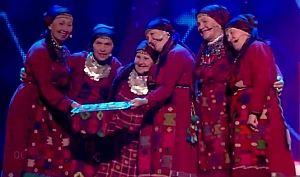 Russia made the final via the bake-off round.  Not the first singer to come as the Borg Queen, Albania's Rona Nishliu sings about a Latin third person reflexive possessive pronoun.
|


