|
Last year's contest was
rubbish. Would this year's be the same? No it wouldn't. From early on
there were signs of interest, if not necessarily signs of quality. And
then Belarus entered in a giant glitterball to perform an occidentally
tinged Ricky Martin number that recalled the finer moments of Turkey
and Greece in the last decade or so. There's a slight touch of Agadoo
or something in the background, with its summery chorus, and things get
increasingly Wild Dances as things progress. There's life in Eurovision
yet.
The interstitial bed music culminates in a low bass stab which we occasionally mistake for an exciting opening to a song. It is probably fair to say that the vast majority of this year's entries do not live up to this false start. Norway are the emphatic exception: they make their entrance in style, and the whole audience wakes up with a start and a cheer as the woofers explode in a volley of grinding synth-bass. Margaret Berger, all curves in a skin-tight white dress, pulls us up the barrel of a Walther PPK for what is a decidedly Bond-ish verse, were The Knife to do a Bond theme. Then the chorus folds open in a flurry of mechanical orchestra hits that put us in mind of Greece's SAGAPO from 2002 (but slinkier and with less sense of lumbar pain). Few go bigger in the hall than this this year, and for all its power there is also an endearing cuteness to Berger's performance. Imagine The Master (being played by George Michael) in a jewel-encrusted black gown. You have just imagined Romania's Cezar, who stands there, growling and gesticulating in a very enrapturing sort of way. "Like a mountain in the sky that is high, so high..." quoth he, glissing into an emasculating falsetto where he will remain for the rest of the song. Male dancers in fleshings start writhing about, like Freddie Mercury pretending to be Nijinsky. Romania are going for the high-camp vote. Countertenor operatics and dubstep wub merge as Cezar grows by a couple of yards in his dress (a trick presaged by Moldova earlier in the night). But for all they throw at it, there is no escaping the fact that underneath it all the song is just a little bit limp, and not as catchy as Dr Alban's number of the same name. A delightful old chap on a bouzouki, surrounded by toned men dressed as netball referees (complete with skirts), lead us into a Vamvakarisian rebetiko number. The Greeks have entered the arena. It's almost a disappointment when they switch tone and launch into an exploding hedgehog of Balkan ska as popularized by Moldova in recent years: suddenly it is no longer so distinctively Greek, and no longer so original and interesting. This is not to say that it is no longer any good, just that it lacks a certain frisson by being in a path more thoroughly trodden. But they deliver their adopted style in style, akimbo-strutting around the stage with the old man acting as a central anchor for our attentions. "Alcohol is free!" they proclaim, demonstrating a lack of intimacy with Swedish taxation models. We raise a glass and they scrape into our jury's top-spot in what is a tight top five. Europe's winner was a step backwards into the 1990s and the Irish Supremacy: twee piping framed Denmark's Celtic martialism. It was far more engaging than any of the Irish winners but it was still a Bad Thing. Probably the best entry of 2013 (if not the whole decade) did not make it to the final. Nor did it reach the semis. Estonia's Winny Puhh came third in their national final with the jaw-slackeningly frenetic heffalump trap that is "Meiecundimees üks Korsakov läks eile Lätti": another great loss to the contest. The best song of the night was not an entrant. The real winner in 2013 was presenter Petra Mede whose Swedish Smörgåsbord interval performance taught us that Swedes are apparently a lot like the British, but with more sex. Even better than her interval song were her three History of Eurovision montages: funny and brilliantly edited, and selecting some of our favourite moments of Eurovision past. Expect this contest to appear in our "Points for Presentation" Top 10 come its next appraisal. For each year's songs we apply our points in the 12-10-8 style of the modern contest, irrespective of how the voting functioned at the time. In brackets is the position the song came on the night:
Europe had Ukraine third, Russia fifth, Italy seventh, Malta eighth, Belgium twelfth, Iceland 17th, Armenia 18th, the UK 19th, Estonia 20th, Germany 21st, Lithuania 22nd, France 23rd, Finland 24th and Spain 25th.
|
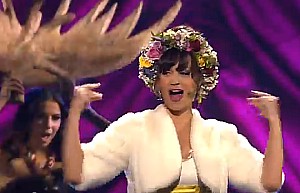 Our host, Petra Mede (plus dancing elk) 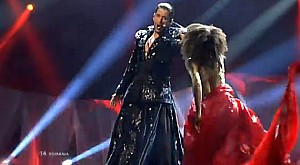 Romania getting high, so high... 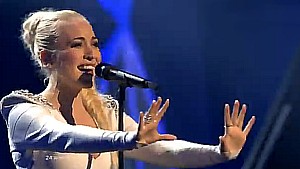 Berger's love is available via RSS or Atom. 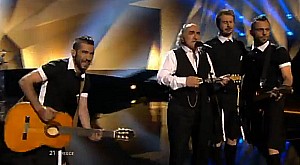 Greece set up a tab. 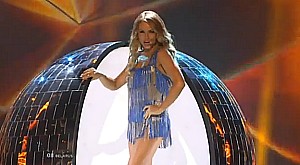 Alyona Lanskaya hatches from her glitterball. 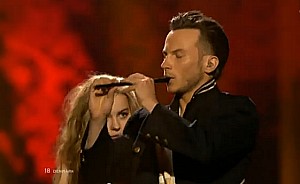 Denmark: "Play me like one of your Irish pipes."
|


