| Luxembourg having won for two
years in a row, the contest went back to the broadcaster of default,
the United Kingdom. Katie Boyle was revived from cold storage, alas
with a hairstyle later made of ill reputed by Margaret Thatcher. The
interval act was the Wombles. The voting system this year reverted to the model whereby each nation's jury consisted of ten members each awarding one point to their favourite song. Although there is no evidence to suggest that the short-voting tactic made possible by the Blankety-Blank voting system in use between 1971-3 (see 1971) was ever employed successfully, the very fact that such a technique was possible (compounded by the simple lack of uniformity in the number of points each jury awarded) was grounds enough for that system to be thrown out. Portugal's entry, arbitrarily selected as the starting pistol for revolution, is a good lounge ballad that is very much reminiscent of the theme tune to Blake's 7. There have been better and more revolutionary Portuguese entries, but there have also been a lot worse and it acquitted itself well. On similar ground, musically, was Belgium. We've not seen many good Irish entries yet, but when we do, they will tend to resemble this year's Belgian proposition: a mop haired man in a suit singing a decent tune that makes our heads jive. Looking east, Yugoslavia came up with something between prog rock and a cop show theme tune, while Israel made their first step towards greatness via the tanktop-wearing all male ensemble Kaveret (aka Poogy-group). Their entry began like metal before turning into amusing strummy art-pop (with curious foreshadowings of Level 42, only proggier and actually some good). The Spanish entry was the most Spanish yet: singer Peret throwing his free-held guitar all about the place, turning it backwards and hammering on the back at one point, in an exciting and fun rumba fiesta to which the shouting of "¡Olé!" is obligatory. Judging this contest was always going to be testing. "Waterloo" is, after all, a great song and a Eurovision classic, although without the familiar fade-out it does seem to go on a little too long. In our reckoning it comes sixth, which may seem surprising, but it was up against some very real competition. Not least the Italian entry, "Si", sung by the 1964 winner Gigliola Cinquetti. Hers is a weird and rather beautifully haunted song with a minor verse flitting about the place and developing into a lovely, swaying chorus with lush backing vocals, which rattles against the rafters before entering a paranoid and frenetic second verse and going on to a delicious torch-waving finalé. It's very much at a different point of the compass to the tight glam-pop of ABBA. It was Europe's second favourite, and our first. For each year's songs we apply our points in the 12-10-8 style of the modern contest, irrespective of how the voting functioned at the time. In brackets is the position the song came on the night:
Europe had the UK (Olivia Newton-John saddled with an awful song she didn't like), Luxembourg (the first Eurovision composition for the legendary Ralph Siegel) and Monaco joint-fourth, Ireland joint-seventh, the debutant Greece eleventh, Finland thirteenth, and Germany joint-last.
|
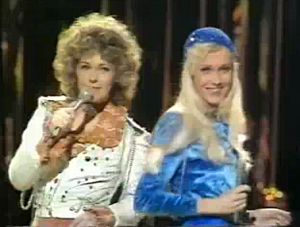 Some Swedish act sing a song about a major European battle. 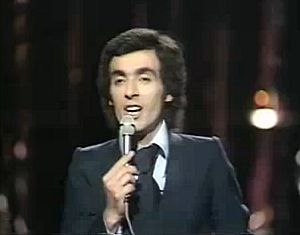 Paulo de Carvalho lights the touch paper...  ...and Israeli tanks roll into Brighton. 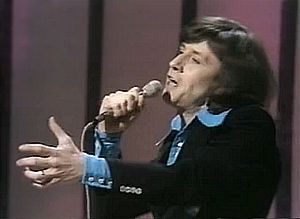 Belgium's Jacques Hustin. 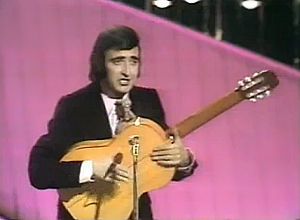 Spain's Peret throws his guitar about. 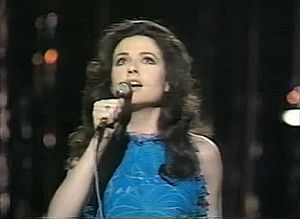 Our winner, Gigliola Cinquetti. |


