| 1975 saw the introduction of the
12-10-8 points system still in use today. Malta returned with a clownish number in the oompah style of earlier successes like "Puppet on a String". Sweden came up with something that sounded like a Bob Ezrin production: all dark cabaret peppered with orchestra stabs and mandolins. As for Germany, they gave us an enjoyable slab of northern soul from the mouth of Joy Fleming who's performance was that of a drunk landlady doing Joe Cocker at the Christmas karaoke. Turkey's debut was rather conventional in the French style: a woman singing a gentle ballad that builds to a rousing chorus. But there were hints of exoticism too, particularly at the ends of verses and in the climax. Monaco took a similar approach, adding an accordion to the mix for a "Those Were The Days" lilt. Continuing the tight glam-pop theme established by ABBA the previous year, and simultaneously echoing the sentiments of the classic Eurovision choruses of old, the Netherlands gave us the enjoyable "Ding-A-Dong" (or more accurately "Ding Dinge Dong") sung by a confused Beverley Sister in her nighty (under the mistaken impression that she's Goldfrap) and owing more than a little to the Grandstand theme-tune. Having seen the Dutch national finals we believe that Teach-In were the wrong choice for this song and that the mercurial 'Debbie' deserved to take the song to Sweden. Her dark-brown performance, like some menacing Dietrich, found umph, funk and passion where Teach-In could only muster jangly pop. When Debbie shouts "Bim-bam-bom" she really means it. Our winner was the Swiss entry, "Mikado": a song that utilizes the sort of repetition that is probably banned under a Geneva convention. A seemingly innocent and sweet introduction gives way to the bouncing "Bananas in Pyjamas" cabaret-style chorus (complete with tuned percussion) that will never ever leave you. Never. Ever. No matter how hard you try. Some might call that annoying. But it's a fine line between annoying and amazing, and this is firmly camped in the latter. It has a good chorus, it knows it, and it will continue to use it until the time is up. It is wise to do so. For each year's songs we apply our points in the 12-10-8 style of the modern contest, irrespective of how the voting functioned at the time. In brackets is the position the song came on the night:
Europe had Italy third, France fourth, Ireland ninth, Spain tenth, Israel eleventh, Yugoslavia joint-13th, Belgium 15th, Portugal 16th and Norway 18th.
|
 Europe's winners, Teach-In. 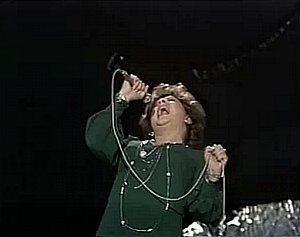 Germany's Joy Fleming lets herself go. 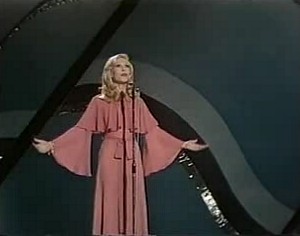 Monaco's entry, Sophie.  Our winner, Simone Drexel's "Mikado". 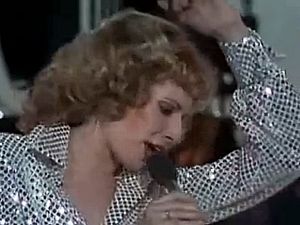 Had Dutch finalist Debbie sung "Dinge Dong" we'd've probably given it the 12pts. |


