| 1979 was one of the best
Eurovision Song Contests: several great songs and a wonderful if
slightly sinister 'de Groot'-style articulated stage backdrop (an
animated version of the concentric rings of the Israel Broadcasting
Authority logo). The Israeli's took the postcard concept particularly
literally, with the help of a troupe of mime artistes. The winning song on the night was that of the hosts, Israel. "Hallelujah" is a sort of "Mack the Knesset" verse constantly repeated. But, in a fine music-hall skit, each verse adds another vocalist. Alas they stop at four, perhaps for budgetary reasons more than a lack of time. Still, it's a nice idea and a decent enough song that mounts up pretty well. 1979 could be the year of the horror soundtrack synthesizer, but there's a flat rate for the meter and the Italian entry, Matia Bazar, can't afford to run their little tiny instruments for very long. As a consequence, their entry becomes a bubbly, strummy thing; a strangely shambolic and amateurish affair, making it all the more endearing; like rooting for Harrogate Railway in the third round of the FA Cup. The female singer's seemingly home-made costume adds to the impression. Belgium's song was clearly pitched at the host market. It was essentially an Israeli entry, but sung by a Ginger Rogers lookalike rather than by the usual white-costumed chorus-line. There's a pop-disco feel, strongly reminiscent of Ottawan. The song was sung in Dutch. Finland's entry is Eleanor Rigby come into money, probably from a Russian oligarch with a collection of native folk songs, while Spain went for the aw-factor with a chorus of kiddiewinks and the sort of marching children's song one might find in a Disney musical. For the second year in a row, Ireland didn't come up with something rubbish. For the second year in a row they gave us a little beardy man, this time Cathal Dunne. Cathal Dunne is a "Happy Man", despite the fact he bares a passing resemblance to Andy Hamilton. In fact, if you squint, it could be the Killers (you've got to squint quite a bit; with your ears). Songs about being happy have a tendency to appear insincere. But Cathal is in love and he's alive and he's got the sun inside. He is undoubtedly a Happy Man, a point which he repeatedly hammers home with relentless, pounding joy bursting forth from the core of his very beard. This brings us to our top three: in our mind the closest top three in the history of the contest. In our internal voting system all three scored the same number of points, causing a bit of controversy in the AView office. We got some two-way ties on some of the poorer contests but they were on nothing very important and we were able to employ our casting vote tie-break system without trouble. But this tie was between three songs that really mattered. The debate is still on-going. The important thing of which to be aware is that all three of these songs are really very good, and that there is very little space between them. Their final arrangement is somewhat arbitrary and could easily have been different had we scored this contest on a different day. With that caveat in mind, let's move on to the next paragraph. The Danish entry, by Tommy Seebach, is called "Disco Tango". What more do I need to type? Curiously, the Finnish jury gave it nothing, though the Greeks and Israelis both gave it 12pts. Germany's entry (which we'll get to in a moment) got 12s from Denmark, Monaco, France and Spain. Greece got 12pts from nobody. The Greeks had obviously seen Jesus Christ Superstar and thought, "how can we do that, but more Greek?". The result was "Sokrati" (example lyric: "Pure and good, the first Christ / Socrates, you superstar!"). A fantastic, powerful chorus opens the song; the singer, Elpida, with her back to us; the backdrop adopting a suitably cruciform arrangement. It's an epic start. In flowing Greek robes, Elpida and her chorus shamble angularly towards us like a zombie attack, occasionally stopping to cry the word "Superstar!" to the heavens. It's hard not to be a little terrified by the lurching amble and the earnest caterwauling of these Socratean zealots. Narrowly it was my favourite, and my casting vote secured it its only 12pts. The compositional genius of Ralph Siegel finally popped out in the form of Germany's entry: "Dschinghis Khan" by Dschinghis Khan. Hu! Ha! More Ottawan-style continental disco-pop, and the biggest raid of the dressing up box yet. A bravely asymmetrical lineup of five singers and a dancer perform a bouncing, energetic kung-fu tribute to everybody's favourite Mongol warlord. For the second year running, the German act sees the removal of a cape, and as the dancer cavorts with the female vocalists one almost expects him to tear off their clothes (but it would take another two years for that sort of thing to enter Eurovision). Maniacal chortles abound. For each year's songs we apply our points in the 12-10-8 style of the modern contest, irrespective of how the voting functioned at the time. In brackets is the position the song came on the night:
Europe had France (a returning Anne-Marie David) third, the UK (Black Lace in their pub-rock days) seventh, Switzerland tenth, Norway (a returning Anita Skorgan) eleventh, the Netherlands twelfth, Luxembourg 13th, Monaco 16th, Sweden 17th, and Austria joint-last. |
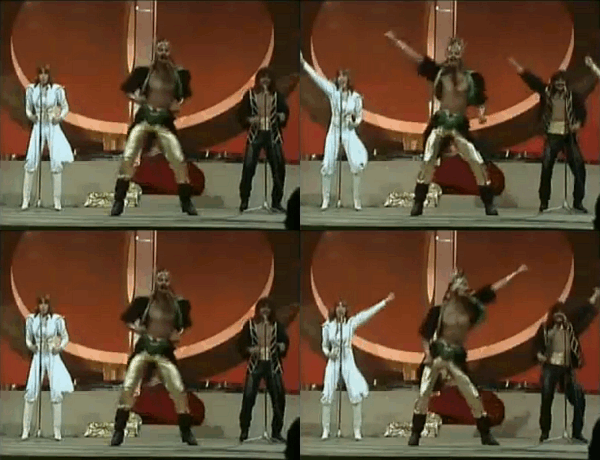 Dschinghis Khan: "Dschinghis Khan". 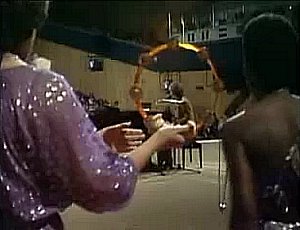 Probably the best camera position of any Eurovision Song Contest: "Disco Tango". 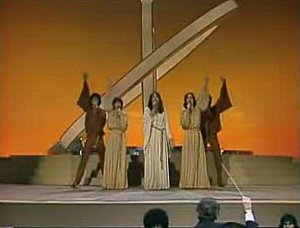 "Sokrati esi Superstar!": Elpida and her cult. 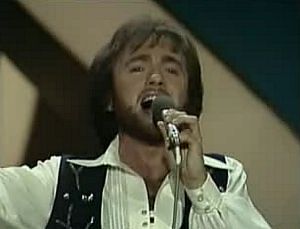 "Happy Man": Cathal Dunne. 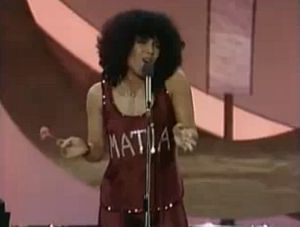 Italy's Matia Bazar. 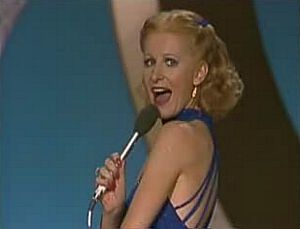 Israel's Belgium's Micha Marah. 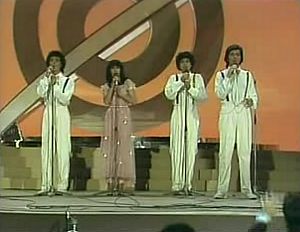 Europe's winners, Israel.
|
Let's now take a snapshot of how the various nations did over the course of the 1970s. For the sake of comparison, the top ten places in the final official standings for each contest are assigned 12-10-8 style points. In the case of a tie for place, the nation that received the highest individual score from a single jury takes the place, and if no resolution is forthcoming from this method then the benefit goes to that nation which our own jury scored the higher. Any ties in the final tally are broken by average performance, and where that is the same they are broken by highest annual placing.
Alongside the '70s snapshot, we'll also take a look at the running total since 1957. Change since the '60s tally is given in brackets.
| 1970s
PERFORMANCE |
1957-1979
PERFORMANCE |
|||||||||
| AVIEW
JURY |
EUROPE | AVIEW JURY | EUROPE | |||||||
| 57pts ▲3 |
 GER |
1 |
 GBR |
78pts = |
134pts ▲1 |
GER |
1 |
GBR |
179pts ▲1 |
|
| 44pts ▲14 |
 POR |
2 |
 FRA |
52pts = |
116pts ▼1 |
 ESP |
2 |
FRA |
157pts ▼1 |
|
| 43pts = |
 FIN |
3 |
ESP |
44pts ▲6 |
98pts = |
 NED |
3 |
 LUX |
98pts = |
|
| 40pts ▲14 |
 BEL |
4 |
 MON |
43pts = |
90pts ▲4 |
FIN |
4 |
 ITA |
91pts = |
|
| 38pts ▲11 |
 SUI |
5 |
GER |
41pts ▲9 |
82pts ▼1 |
ITA |
5 |
MON |
89pts ▲1 |
|
| 38pts ▲3 |
MON |
6 |
 ISR |
40pts NEW |
76pts ▲3 |
LUX |
6 |
SUI |
80pts ▼1 |
|
| 37pts ▼6 |
ESP |
7 |
LUX |
40pts ▼4 |
76pts ▲3 |
MON |
7 |
NED |
75pts ▲2 |
|
| 33pts ▼1 |
LUX |
8 |
 IRL |
38pts ▼1 |
66pts ▲4 |
 AUT |
8 |
GER |
75pts ▲4 |
|
| 32pts ▲4 |
AUT |
9 |
NED |
37pts ▲7 |
66pts ▼3 |
 SWE |
9 |
ESP |
74pts ▲5 |
|
| 29pts ▼8 |
NED |
10 |
ITA |
35pts ▼5 |
65pts ▼5 |
GBR |
10 |
IRL |
70pts ▲3 |
|
| 25pts ▲7 |
IRL |
11 |
SUI |
27pts ▼5 |
61pts ▲4 |
BEL |
11 |
SWE |
60pts = |
|
| 23pts NEW |
ISR |
12 |
SWE |
26pts ▼1 |
60pts ▲5 |
POR |
12 |
BEL |
58pts ▼2 |
|
| 23pts ▼3 |
 NOR |
13 |
BEL |
22pts ▼1 |
58pts ▲3 |
SUI |
13 |
AUT |
51pts ▼5 |
|
| 22pts NEW |
 GRE |
14 |
FIN |
13pts ▲3 |
56pts ▼7 |
 DEN |
14 |
DEN |
47pts ▼7 |
|
| 22pts ▼9 |
ITA |
15 |
GRE |
12pts NEW |
54pts ▼2 |
NOR |
15 | ISR |
40pts NEW |
|
| 15pts ▼2 |
 YUG |
16 |
AUT |
12pts ▼8 |
44pts ▼5 |
FRA |
16 |
NOR |
26pts ▼1 |
|
| 13pts ▼12 |
SWE |
17 |
POR |
9pts ▲1 |
37pts ▼3 |
YUG |
17 |
FIN |
22pts = |
|
| 12pts NEW |
 MLT |
18 |
DEN |
5pts ▼8 |
28pts = |
IRL |
18 |
YUG |
21pts ▼2 |
|
| 10pts NEW |
 TUR |
19 |
NOR |
4pts ▼6 |
23pts NEW |
ISR |
19 |
GRE |
12pts NEW |
|
| 8pts ▼9 |
DEN |
20 |
YUG |
2pts ▼5 |
22pts NEW |
GRE |
20 |
POR |
9pts ▼2 |
|
| 8pts ▼9 |
FRA |
21 |
TUR |
0pts NEW |
12pts NEW |
MLT |
21 |
TUR |
0pts NEW |
|
| 8pts ▼14 |
GBR |
22 |
MLT |
0pts NEW |
10pts NEW |
TUR |
22 |
MLT |
0pts NEW |
|
We and the Europe of the day could not disagree much more over the merits or not of the United Kingdom's entries over the course of the 1970s. We also have a more balanced distribution of points: Germany's lead is less than a win away and we have no nul points entries in the table. After a relatively poor showing in the 1960s, Germany are back on top, switching places with Spain on the overall leaderboard. There's a swap at the top of the official leaderboard too, with the UK's sheer weight of 2nd places (four of them in the 1970s) taking its toll on the less consistent France. Again, central Europe dominates the top places of the official board with only the UK, Spain and Ireland coming from (very slightly) further afield. We have a bit more balance, with Spain, Finland, Austria, Sweden and the UK (the latter very much in the descendant). Europe however do have the highest placed new entry in the form of Israel, scoring 40pts to our 23. For us, Austria and Belgium scored two wins during the '70s. Israel and Luxumburg managed the same feat in real life.