| Last year's winners Israel not
taking part (see the Politics section below) the contest returned to
The Hague, ensuring another exciting (and rather frightening) Roland de
Groot set: a strange silver mask thing with red glowing eyes. To
cut
costs, each entry was introduced by a national spokesperson rather than
by a postcard (Noel Edmonds in the UK's case). 1980 also saw the
introduction of the modern voting protocol: issuing songs in
consecutive order of points given (1, 2, 3, 4, 5, 6, 7, 8, 10, 12)
rather than in order of appearance. This put to an end the days of
miscounted points and also added an extra dimension of mild suspense. Following the triumph (in our mind) of "Dschinghis Khan", this year's Ralph Siegel entry (under the flag of Luxembourg) was a Gainsbourgian piece of cartoonish pop called "Papa Pingouin". Penguin costumes were involved. The song mainly consisted of the lyrics: "Le papa pingouin / le papa pingouin / Le papa, le papa, le papa pingouin" being sung by a pair of twins in coordinated outfits. Belgium's entry was of particular note. Telex eschewed the orchestra with their synth-pop number "Euro-Vision", complete with redundant hardware on a trellis-table for effect, and a self-referential quote of Charpentier's "Te Deum" at the end. They also employed props: confetti and a camera to modest effect. But the song was a bit too relaxed and low-key to engage. Eurovision needs a bit more umph than Telex offered: they could've done with something a little less "Europe Endless" and a little more "Trans-Europe Express". Greece gave us a particularly twee little number, "Autostop", with very '60s orchestration, and some heart-warming choreography, plus the almost obligatory sirtaki moment. Spain took to the stage in evening-wear (the woman doing the increasingly standard cape removal at half-time) for an at times quite haunting, at times rather brassy and dramatic number. It's all very tense, but doesn't quite do enough with it. Austria's entry was particularly slick, blending a funky, synth-draped easy listening verse with a soaring, aspirational chorus. The 1980s has arrived. No prisoners will be taken. Our last hope lies in the form of Portugal's José Cid, a sort of cross between Roy Orbison and Elton John. With a verse stolen from "Eloise", and a fantastic joyous chorus sprinkled with a fair amount of '70s glitz, he wins our hearts, and a very final false end catches out the audience. Eurovision seemed to be celebrating other media this year. Switzerland gave us "Cinéma" while Katja Ebstein made her third appearance in the contest for Germany's entry, "Theater". Such was the quality of this years entrants that our jury didn't give "Theatre" any points, though it was an entertaining enough little cabaret number (and penned by Ralph Siegel). We were probably all a bit too disturbed by the excessive use of mime artistes. Europe, in a truly disgusting moment, voted Ireland's Johnny Logan (the poor man's David Cassidy) as their winner, with his stupid, floppy, Jamie Oliver, pouting, wet, punchable, blubbering, face and his bloody awful mawkish, sentimental drivel of a song. Still, it's quite a performance, albeit a performance that deserves a clip round the ear. Of more interest was Morocco's only entry to date: a rather grand thing, part European, part North African, and curiously oriental throughout. Strangely beautiful and beautifully strange. It came second to last on the night. So often Europe gets it so so wrong. For each year's songs we apply our points in the 12-10-8 style of the modern contest, irrespective of how the voting functioned at the time. In brackets is the position the song came on the night:
Europe, as already regretted, put Ireland first, with Germany second, the UK third (a pastel-hued congregation of drama-school types called Prima Donna), Switzerland fourth, Italy sixth, Sweden tenth, France eleventh, Denmark 14th and Finland 19th.
|
 Europe's winner, Johnny Logan. A closer shot would just make you feel aggressive. 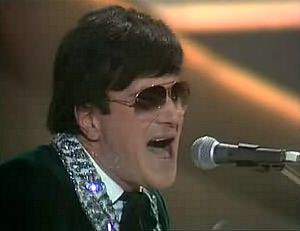 Our winner, Portugal's José Cid. 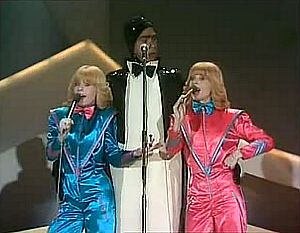 Luxembourg's "Papa Pingouin".  Telex: "Euro-Vision".  Anna Vissi and the Epikouri. 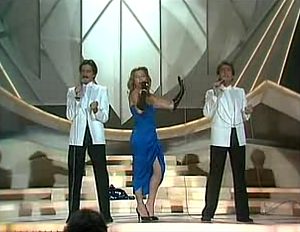 Spain's entry, Trigo Limpio.  Germany's Katja Ebstein.  Austria's entry, Blue Danube. |


