| Germany, hosting the contest for
only the second time, decided to get their revenge on the rest of
Europe by doing the proceedings trilingually (English, French and
German). As a consequence, the voting (complete with a rather partisan
audience and several errors of translation) went on for over an hour,
stretching the whole contest beyond the three hour mark for the first
time. Someone with too much time on their hands counted thirteen
language mistakes made by our presenter, Marlene Charell, during the
voting. She also got the name of the Norwegian conductor wrong,
apparently making something up and hoping for the best. Still, all good
clean entertainment. The stage set looks like a giant electric heater. Yugoslavia gave us a fun little song, with a Reece Dinsdale lookalike attempting to capture the spirit of Spain's jolly, folksy 1977 entry. Behind him, two broadly smiling women (let's call them Rita and Sue), resplendent in leg-warmers, clap like idiots, as an accordion plays at the side. "Džuli", yodels Reece at regular intervals. In the last few years Belgium had shown itself to be the nation most in touch with new musical trends, and this year was no exception. Pas de Deux were, essentially, a mildly new romantic female duo and their song "Rendez-vous" is a rhythmic and somewhat industrial number with hints of that African-influenced corner of the new wave explored by the likes of Bow Wow Wow and late Slits. It's very repetitive (the lyrics are, pretty much, just "Rendez-vous / Maar de maat is vol en m'n kop is toe" ("Rendezvous / But that's the limit and I shut up")) and in the real world would be a fairly simple synth job, but here it is awash with lush strings and brass. Whether that works in its favour or not is something we disagreed on a little. But it was, at least, different. Not quite as different as Spain's entry though, which was truly amazing stuff. In a bold move they went with a particularly hard-core Moorish flamenco, far from the safety of European tonal conventions. The result is a loud, aggressive, mechanical and profoundly North African performance. Petrifying stuff. The wild Remedios Amaya, performing barefoot, flourishes her dress in some wonderful semi-colons, though had she done a few more she might've thawed the hearts of a few more juries and scored more than nul points. But we already know how blinkered Eurovision judges can be. The other nul points went to Turkey. Increasingly one of the more dependable nations in our view, it was Turkey's turn in the dressing up box this year. After Switzerland's "Theatre", and Germany's "Cinema" in 1980, Turkey decided to raise the stakes and give us "Opera". Our vocalist, Çetin Alp, looks like John Travolta trying to do an Elvis impersonation. His backing vocalists are each dressed in random historical costume in an attempt to evoke the characters of the great operas. The song opens with an operatically delivered ascending harmony and then turns into a rather conventional pop ballad (I say conventional, nothing is conventional with Turkey: the verse is suitably minor and moody, and the lightly funky bridge is epically operatic in ambition) into which are dropped the names of famous opera composers. Indeed, if you saw the first and last minutes in isolation, having nipped to the toilet for the forty seconds in between, you'd think this was just another fairly decent Eurovision entry with nothing much of any real distinction. But rammed into that gap, quite incongruously is the sort of madness that turns a song from alright to a work of genius. It comes, and then forty seconds later it is forgotten, such that you begin to question that it ever happened at all. For forty seconds, "Opera" turns into a wildly silly, bright, bouncy, charlstonable 1920s swing dance-band number, with the clippily delivered lyric "Opera! / Opera! / Opera! Opera! Opera!". It is a fine forty seconds and it is not an hallucination. Israel's entry was their best yet. Faintly reminiscent of Siw Malmkvist's "Primaballerina" from 1969, but with all the good bits of an Israeli entry thrown in. A very "Jesus Christ Superstar" introduction gives way to a thoroughly enjoyable and eminently interactive number (anyone can join in with the "Khay khay khay"-ing of the chorus). Great stuff. The winning song on the night was a rather frosty affair from Luxembourg: another soaring power-ballad of the kind that would dominate and almost destroy the contest. Thanks to its frostiness, its minor sections and a slightly unconventional climax it's not nearly as awful as some of its descendants; in fact it's by no means a bad song. But when judged alongside the last two Luxembourg winners (1972 and 1973) one can already discern the rot setting in. There's something far too slick and plastic lurking at the heart of this song: the definite whiff of a 'winning formula' being worked out. Finland, having won our hearts in 1977 with Monica Aspelund, this year gave us her little sister, Ami Aspelund. For "Lapponia", read "Fantasiaa". The song, possessed of some considerable Abba-ishness, cracks open with a "Holding Out For A Hero" introduction and is full of icy little flourishes and stabs, one of which sounds like the Crystal Maze. The orchestration is bang on; the pounding rhythm always a welcome part of our jury's 'winning formula' such as we have one. The key change is particularly well put together, with a false start. Easily the best moment comes at the end of the first chorus, when the three male backing vocalists (seemingly in striped mittens) lean, mysteriously, into the spotlight and deliver their sinister interjection only to be pulled back to the upright by the powerful attractive force of Aspelund's ridiculously broad peplum: so hippy that it makes the poor woman waddle like a duck. She, like her sister, delivers some great gestures and eye movements (many of which are only just caught by the camera) and the whole thing is just fantastic, as is appropriate (the promo video is great too). It is our winner in what is a particularly strong year of Eurovision.
Europe, as already regretted, put Luxembourg first, with Germany fifth, the Netherlands seventh, France eighth, Austria joint-ninth, Italy joint-eleventh, Portugal 13th, Greece 14th, Switzerland 15th and Denmark 17th. |
 Our winner, Ami Aspelund. 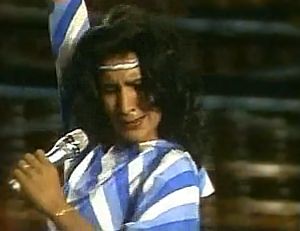 Remedios Amaya frightens the judges. 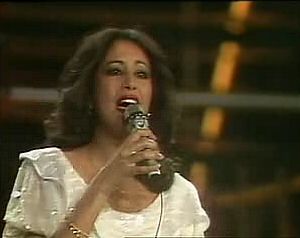 Ofra Haza: "Khay! Khay! Khay!"  Çetin Alp & the Short Waves: "Opera! Opera! Opera!" 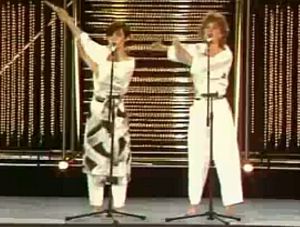 Belgium's Pas de Deux. 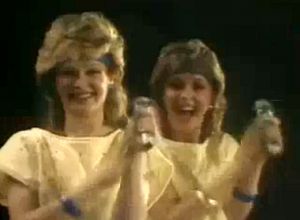 Yugoslavia's backing vocalists.  Europe's winner: Corinne Hermès revives the power ballad. ⇦1982 / HOME / 1984 ⇨ |


