| Welcome to Zagreb, Yugoslavia.
Europe is feeling slightly different this year because Germany now
no-longer has a bloody great wall through it. Next door in Romania,
there's been a rather bloody revolution. It's all a bit... something,
and Europe's lyricists have noticed. A couple of songs deal with
matters Berlin and there's a curious euphoria about the place. In an
attempt to put down this euphoria, Yugoslavian television introduced
the first mascot to Eurovision: an annoying animated cat that populates
the postcards. A backing tape problem saw an hilarious false start for the opening Spanish entry, showing up the miming nature of the stage band. That's not why we ranked it fourth. It's a good latin dance number with more than a hint of a call to prayer, even if it does feel a lot, at times, like an episode of the Clothes Show. Embracing the new Europe, Norway gave us "Brandenburger Tor" (which rhymes with L.A. Law) sung by Ketil Stokkan (a cross between Michael Schumacher and John Lithgow). Nothing about it should be any good at all, and yet it has an amazingly endearing chorus that is difficult to put down. A quiet rendition near the end is followed by a build up that should in an ideal world go on building for another hour or so. If you want to wave your lighter, there are few more appropriate locations than here. Europe disagreed and it came joint-last. Denmark's entry "Hallo hallo" was a fun bit of saxophone-smeared late '80s pop along the same lines as much of last year's content, but with a more obvious male dancer and a worryingly fixed grin on singer Lonnie Devantier's face. Iceland adopted a formula that would serve them well until the purges of the semi-final era: a bouncy "Waterloo" rhythm, a bubbly duet and a swingy pop tune. But the best of the bubble-gum pop offerings came from Yugoslavia. Theirs was a particularly fresh and well produced number with Marilyn Monroe-alike Tajči wiggling about the place excitedly throughout. A misplaced guitar-solo and a slightly dodgy key-change were not enough to put us off what is a perfect and fun pop chorus. The UK's entry was... amazing is very much the wrong word. It was an uplifting world-saving anthem with a chorus stolen from Foreigner. They'd like to teach the world to sing but they can't afford the rights. The singer, Emma, looks barely legal under the new age-rules. Dressed entirely in red (including tights and shoes) and surrounded by women dressed entirely in blue (likewise) there's something Handmaid's Tale about the performance, almost certainly unintentionally (unless the wardrobe designer was particularly cynical about the song's message). The song is so sickly sweet and cheesy that it manages to come through the terrifying mirror of taste and become strangely enjoyable, like harvesting pus from a clap-sore. Italy won the contest this year with a shameless anthem to European economic unity that happened by chance to also fit with the events in Germany. Toto Cutugno's "Insieme: 1992" anticipates the signing of the Maastricht treaty, the formation of the European Union and the creation of the single market, which is a silly thing to sing a song about. It is the regular repetition of the English lyric "Unite unite Europe!" coupled to a lightly emotional and vaguely rousing pop-rock ballad that doubtless captured the judges' sentimental hearts. Others of a more cynical bent (i.e. us) might find it a bit disturbing. For each year's songs we apply our points in the 12-10-8 style of the modern contest, irrespective of how the voting functioned at the time. In brackets is the position the song came on the night:
As mentioned, Europe voted Italy as its winner, with France and Ireland joint-second, Austria tenth, Switzerland eleventh, Belgium twelfth, Luxembourg 13th, Cyprus 14th, Sweden 16th, Turkey 17th, Greece 19th, and Finland joint-last.
|
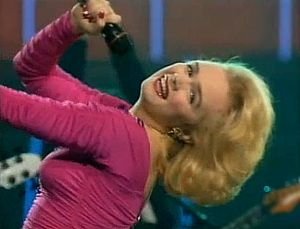 Our winner, the delightful Tajči. 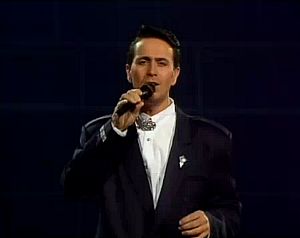 Ketil Stokkan sings about a gate. 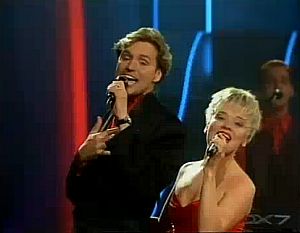 Iceland's Stjórnin.  "Hallo Hallo": Lonnie Devantier. 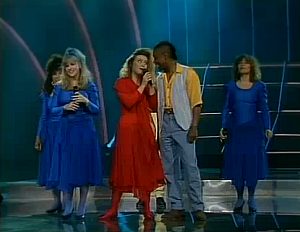 The Gileadian entry, Emma. 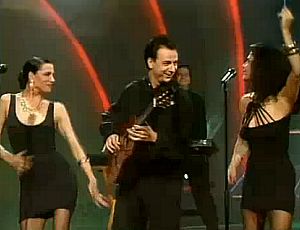 He knows that everybody knows he's miming. The Spanish entry, Azúcar Moreno. 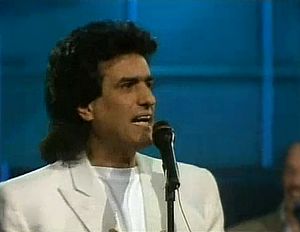 Europe's winner seeks to unite Europe. |


