| Two things of note from this
year's contest: the interval act, "Riverdance", made the world a bit
madder than usual for the next few years, while the voting introduced a
video link to the spokesperson allowing us to see them in all their
weird foreignness. With no Israel, Turkey or even Belgium, this year was always going to struggle to entertain. Finland did their best by having two women in their underwear and overcoats, flanked by some typically early-'90s black male dancers busting some rad moves. The song is suitably dark in tone and the rule-bending English chorus is adequate enough, making it one of the stand-out tracks this year. Cyprus, with the weight of most of the Mediterranean on their shoulders, gave us a rather retro Greek entry that dabbled with power-balladry without plumbing the same depths as most of Europe this year. It went particularly mad in the second half with lots of streaking strings zipping about the place and with much arm-waving from our singer, Evridiki. Estonia's entry, looking a bit like an English teacher, gave us the archetypal Eurovision pop-ballad of the era, with descant guitars, a forceful middle eight and a rousing, anthemic chorus made from tin-plate and glitter. All it was missing was the key-change. Far more of interest was the French entry: a particularly barking indie-goth thing with a shimmering choppy guitar rhythm and lush strings; the mad-hatted Nina Morato dressed as Puss-in-Boots, miaowing and screaming and breath-lessly informing us that she's a real boy. The Russian entry, one of several with a hint of Broadway to the song, also had an interesting choice of wardrobe, with an orange dress that was a cross between Borg Queen and Angel of the North. But of all the songs of 1994, one stands out far above the others, taking its rightful place in the pantheon of Eurovision greatness. After a number of years in the wilderness, Ralph Siegel recaptured his old form to deliver "Wir geben 'ne Party". The song was performed by MeKaDo, a sort of heavily '90s version of the Andrews Sisters. They are possessed of the one thing nobody else seems to have had in 1994, namely a pulse. They also have Wincey Willis on drums (not to mention one of 1977's Silver Convention on keyboards). With a dance-pop beat, orchestra hits, flourishing brass fills, and a bountifully joyous sense of fun, this is what a schlager rave must be like. Oh yeah. And that's before we've even reached the rap section. Excellent stuff, well paced, brilliantly choreographed and effortlessly performed. The actual winner on the night was the dreadful Irish entry, "Rock 'n' roll kids": a piano dirge completely devoid of even the slightest morsel of either rock or roll. Vomit-inducingly sickly and sentimental, again, as with last year, it was Radio 2 fodder, but this time of the very worst kind. Even Bryan Adams would be ashamed of it. Thank heavens for mad Germans. For each year's songs we apply our points in the 12-10-8 style of the modern contest, irrespective of how the voting functioned at the time. In brackets is the position the song came on the night:
As already noted with a sense of disgust, Europe gave Ireland their third win in a row, making them the most successful nation in Eurovision history. Poland took second, Malta were fifth, Norway sixth, Portugal eighth, the UK tenth, Iceland twelfth, Sweden 13th, Bosnia & Herzegovina 15th, Croatia 16th, Spain 18th, Slovakia and Switzerland joint-19th, Romania 21st and Lithuania 25th.
|
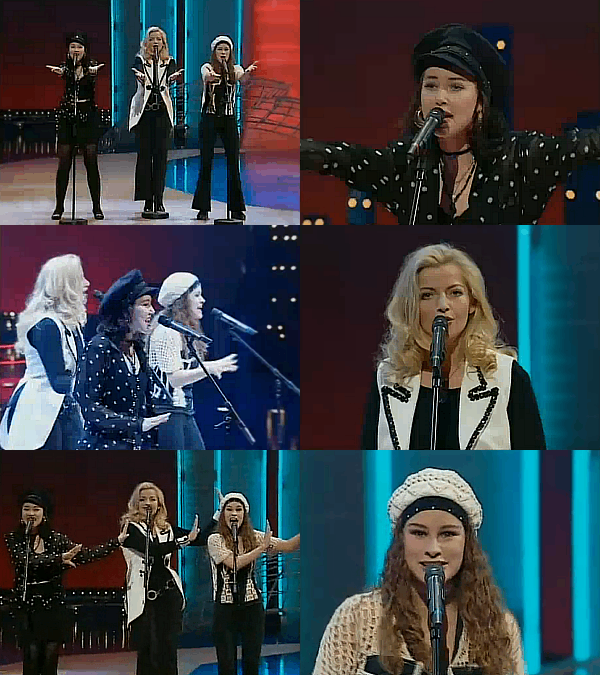 "Wir geben 'ne Party".  Finland's CatCat. 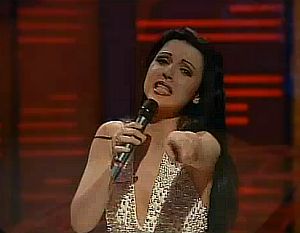 Cyprus's Evridiki. 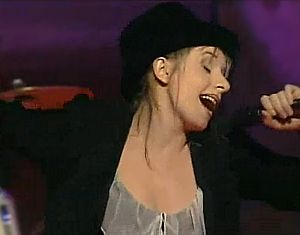 Definitely not barking: Nina Morato.  Russia's Angel of the East, Youddiph. 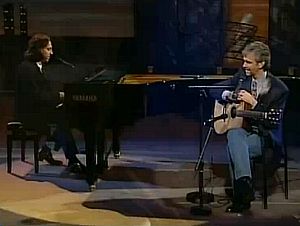 Europe's winner, Ireland (again again). ⇦1993 / HOME / 1995 ⇨ |


