| 1977 is undoubtedly one of the
two greatest Eurovision Song Contests ever staged. There is stuff in
1977 to which we were unable to award a single point yet which in
another year might well have taken the full twelve. That is the level
at which we are operating here. For example, the Greek entry, "Mathima
Solfege", was performed a little lacklusterly on the night and so
gained no votes at all from our jury (despite being a decent song), yet
the promo version is very good indeed (helped to some extent by the
furious Sesame Street / Brady Bunch video effects as well as by the
studio production). A better performance might well have moved them
into a points-scoring position. Likewise, the contest-winning French
entry, "L'oiseau et l'enfant", ranked eleventh on our jury so scoring
nul-points from our perspective despite being perfectly good. Well, not
perfectly, but, you know, it's a turn of phrase. The song's a rather
lovely spirally buildy thing and it's easy to see how it won. But there
were ten better songs on the night: The Netherlands employed Blake's 7's Servalan as their singer, and dressed her as a giant shrimp. Like France's entry this was a good, solid, torch-waving anthem of the sort that Europe breathes on an annual basis. Monaco sounded like they might do the same until the chorus arrived and it became clear that they were just going to sing "Those Were The Days". But, hey, "Those Were The Days" is a good song. If you're going to rip off a song, make sure it's a good one and do a good job of it. Monaco did. Norway gave us the adorable Anita Skorgan and the fantastic "Casanova" (yes, we're already at the "fantastic" stage and we're only at the five points mark). From the ELO-like introduction alone it is clear that we are on strong ground; that it goes into Olivia Newton John territory (proper OLN, not that abomination she sang in Eurovision in 1974) just adds to the excitement: a wonderfully twee number with a head-swaying chorus and the faintest aroma of wakka-wakka guitar. The cartoonish bridge from the verse to the chorus is particularly fetching. Switzerland's entry, "Swiss Lady", takes some acclimatizing to appreciate fully. A sensible first reaction is to recoil from an ensemble of white-suited hat-wearers, one of whom looks like Elton John, another (on an alpine horn) like Frank Zappa. A third communicates to us through the piccolo, and it is through him that we might first begin to appreciate their offering, seeing beyond the Chas & Dave -ness of it all and finding a rather charming happy little ditty dancing beneath. 1977 was the year that Eurovision embraced disco. Luxembourg's entry, owing a lot to the likes of Serge Gainsbourg and Pierre Henry, is a repetitive, seductive number that mainly consists of the words "Frère Jacques" being sung in a handful of different keys to a delicious disco groove overlaid with tubular bells and cross-dressed urchin backing vocals. Germany and Belgium (both singing in English having made their selections at the right side of a reintroduction to the language restriction) also took to the dance floor but with a more Motown sound. Both entries have a very professional, commercially viable feel, and are performed by well choreographed vocal groups. The German entry, coming first, kind of eclipses the Belgian which seems almost surplus to requirements as a result. Indeed it takes a week or two for "A Million in One, Two, Three" by Dream Express (1970's Dutch entrants Hearts of Soul, plus one) to properly bed into the brain, by which point you will have either become convinced of its quality or you will have trepanned yourself into casualty. We went with the former option, and as such our bedroom walls aren't covered in blood. The German song, "Telegram" by Silver Convention, (cf. "Telefon Telefon", 1957) is off to a great start straight away, thanks to the employment of a genuine telegraph machine which sprinkles dots and dashes of morse throughout the piece. It's a great, slickly delivered song made all the better by the fascinating routine the singers perform with their arms. You'll be trying it with your friends if you've anything about you. Spain's entry, sung by the bouyant, Roy Castle-ish Micky accompanied on stage by three backing singers, a jug blower and a seated young woman in silver cowboy boots pretending to play a banjo, is a happy-go-lucky affair rather reminiscent of "Young at Heart" by The Bluebells. And then there's the really special stuff... Finland's Monica Aspelund, a sort of cross between Inger Berggren and Marion Rung from the 1962 contest, puts in a truly breathtaking performance: lots of expressive eyes and twisting arm gestures, some frosty breathing and a blood-curdling scream. All the while, a Haino lookalike looks on from the piano. Even if one could somehow ignore the brilliant Aspelund, the song itself, nationalistically entitled "Lapponia" is a great piece of work, with its clappy, timp-laden chorus and some fantastic string arrangements, not to mention the incongruous, melodramatic instrumental section and the doo-wop bit that precedes that scream. That scream... But Aspelund makes a great song into something extra special. Even if you can't bring yourself to doing the arm-movements to "Telegram", there is no way on Earth that it is possible to resist mimicking Monica's moves. Only the armless can sit impassive. Eurovision doesn't get much better than this. Music is love for you and for me; music is money for the record company. Sometimes words are not enough to describe the pure... absolute... perfection of a song. The Austrian entry, Schmetterlinge's "Boom Boom Boomerang" is that song. Poor "Lapponia" would win pretty much every Eurovision apart from this one. The perfection lies not only in the song, but again also in the performance itself: the double-sided costumes, the cigars, masks and £5 notes, and most importantly: the delightful choreography. Even the delicate first movement is timed exquisitely with the rotation of the stage-set. That the costumes make their legs look really skinny just adds to the fun. A well observed take on the likes of the Les Humphries singers last year, as a song and a performance it is both a cynical satire and an entertaining song and dance tour-de-force; simultaneously for and against everything that Eurovision stands for. But screw that; it has silly dancing and the lyrics "Boom boom boomerang snadderydang / kangaroo, boogaloo, didgeridoo / ding dong, sing the song / hear the guitar twang / Kojak, hijack, me and you". For each year's songs we apply our points in the 12-10-8 style of the modern contest, irrespective of how the voting functioned at the time. In brackets is the position the song came on the night:
As already mentioned, Europe had France in first place; second were the UK with the slightly annoying double-piano duet of Lynsey De Paul & Mike Moran; Ireland were third, Greece fifth, Israel eleventh, Italy 13th, Portugal joint-14th, and a particularly (perhaps deliberately) dreadful Sweden came last. |
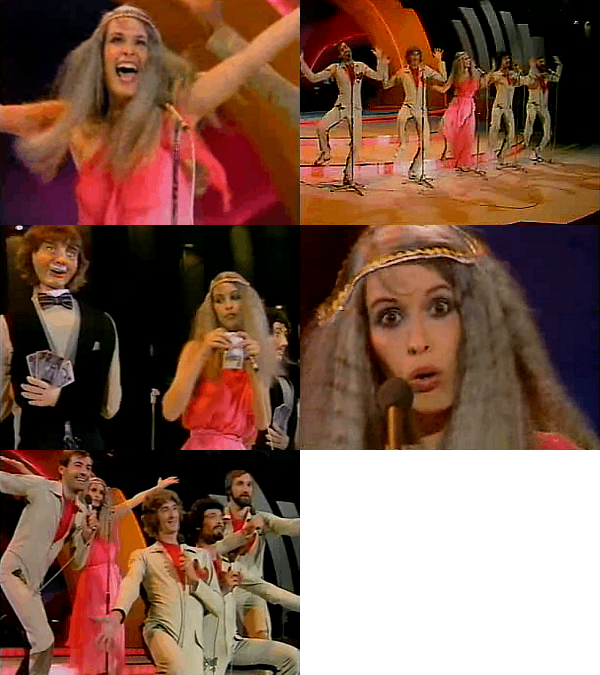 "Boom Boom Boomerang". 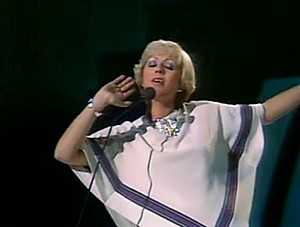 Monica Aspelund: "Lapponia".  Silver Convention mid-way through their elaborate dial-up routine.  The joyous "Enséñame a cantar". 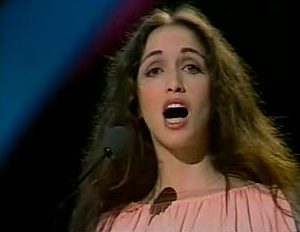 "Frère Jacques".  "Swiss Lady". 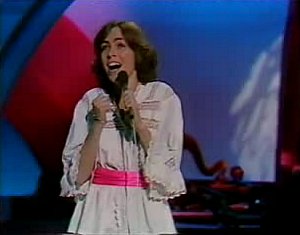 The adorable Anita Skorgan. 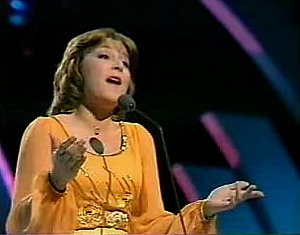 Europe's winner, Marie Myriam.
|


