And so back to Dublin we go; the
first time we've made three visits to the same specific venue.
Perhaps spurred into action by Gina G, last year, 1997's entrants were
noticeably more up-beat than in recent years. Just as disco had arrived
in Eurovision in 1977, so the dance scene hit twenty years later.
Austria impressed with some fantastic choreography in their slinky
jazz-funk pop number "One step", Bettina Soriat flicking her
PVC-encased body about the place with a professionalism never really
seen before in the contest, thanks in part to a head-mic. Also in PVC
was the singer of the Cypriot entry. Hers is for the most part a
typically Mediterranean number and by no means especially original. But
then everyone gets in a line and they start going "tabababadam". That's
the sort of trick that takes some beating in our book.
Russia gave us hardened rock chick Alla Pugacheva (a sort of female
Ozzy Osbourne) and a power-ballad that's done time in the Red Army. It
really needed a full military choir to come in at the end, but alas
that never transpired. What did transpire just about made up for it
though: "bravo"s, and a fantastic pizzicato orchestra flourish
transforming an interesting nationalistic take on the power-ballad into
something rather special.
The name of the Dutch act is Mrs. Einstein. Sounds like a Paul
McCartney song, doesn't it? "Mrs. Einstein, oh Mrs. Einstein, your
husband is a clever man / a husband is a relative but you are
relatively sad." or some such drivel. And indeed, this song sounds like
a McCartney work, but not one of his oompah vignettes. No, this is
"Live & Let Die" (and in equal measure "MacArthur's Park"). It's
being performed by five women (women being definitely the right word;
these are not girls by any stretch of the term) who sway about the
stage singing something about time. The orchestra squeals around them
excitedly, glad of something exciting to do, and the result is "Live
& Let Die" with a harmonizing female vocal group sashaying in the
back of the speedboat (which has got to be an improvement by anybody's
measure).
The winning song on the night received a record breaking ten 12pts
votes on its way to the highest winning total yet. Katrina & The
Waves' "Love shine a light" is a jangly anthem to world peace of the
kind for which Europe goes soppy. It's a sort of "Insieme: 1992"
("Unite Unite Europe!") for the post Cold War world, and although it
gets going pretty quickly, and makes a good deal of what little it has,
it alas has very little indeed beyond a basic jangly optimism. The
chorus for instance never goes very far and it's all consequently a
little flat and uninteresting in a way that Céline Dion and the
Luxembourg set, to their credit, never were. Still, it could be a lot
worse.
For each year's songs we apply our points in the 12-10-8 style of the
modern contest, irrespective of how the voting functioned at the time.
In brackets is the position the song came on the night:
HERE
ARE THE VOTINGS
OF THE AVIEW JURY:
|
12pts
(=22nd)
|

NED |
Mrs.
Einstein
"Niemand heeft nog tijd" |
10pts
(5th)
|

CYP |
Hara
& Andreas Konstantinou
"Mana Mou" (Μάνα μου) |
8pts
(15th)
|

RUS |
Alla
Pugacheva
"Primadonna" (Примадонна) |
7pts
(21st)
|

AUT |
Bettina
Soriat
"One Step" |
6pts
(=12th)
|

GRE |
Marianna
Zorba
"Horepse" (Χόρεψε) |
5pts
(16th)
|

DEN |
Kølig
Kaj
"Stemmen i mit liv" |
4pts
(3rd)
|

TUR |
Şebnem
Paker & Grup Etnic
"Dinle" |
3pts
(11th)
|

POL |
Anna
Maria Jopek
"Ale jestem" |
2pts
(20th)
|

ISL |
Paul
Oscar
"Minn hinsti dans"
|
1pt
(9th)
|

MLT
|
Debbie
Scerri
"Let Me Fly"
|
Europe, as mentioned, gave first place to the United Kingdom. Ireland
were second, Italy fourth, Spain sixth, France seventh, Estonia eighth,
Slovenia tenth, Hungary joint-twelfth, Sweden 14th, Croatia 17th,
Germany and Bosnia & Herzegovina joint-18th, Switzerland
joint-22nd, and Norway and Portugal joint-last.
|

Our winners, Mrs. Einstein.

Austria's Bettina Soriat
shows us the future of Eurovision.
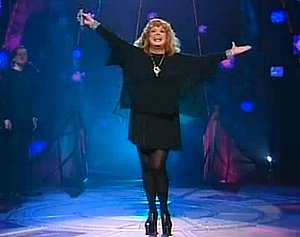
Alla Pugacheva, the forces' sweetheart.

"Tabababadam!": the Cypriot entry.

"Let the love light curry": Europe's winner.
POLITICS
|
The
EBU introduced the following tweak to the relegation rule: the
countries with the lowest average scores over the previous four years
would be excluded from this year's contest, and those with the lowest
average over the previous five years would be excluded from individual
contests in future years. Excluded nations would be entitled automatic
entry to the following contest. Contests would be limited to 25
entrants, with exclusions in operation as necessary to reach that
target.
The contest coincided with a day of remembrance in Israel, making them
absent for the second year running and the third time in four years.
Telephone voting replaced the juries in Austria, Germany, Sweden,
Switzerland and the UK.
|
|