SEGRAVE
| HOUSE COLOUR: |
Red |
| HOUSE EMBLEM: |
Lion |
| SPECIALISM: |
Science |
|
|
| Segrave
is the tallest building on campus, having three floors, and stands at
about
30'. It is essentially a replica of Osborne, but with an extra floor
and
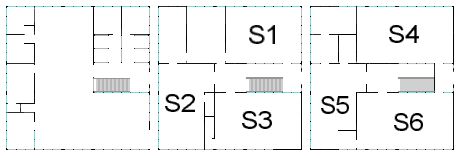
one less flyover. The plan above shows the arrangement of the rooms as
they stood in the mid-'90s, although the odd cupboard or wall divide
might
be slightly out. Entry is from the east.
In
the '90s there
was (intermitently) a tuck shop in the common room (the central room on
the west wall), and the pinball machine was one of the better ones (it
had a red monster on it, and an electronic scoreboard). The left
study-room
was used as a classroom by Media Studies, and contained the Segrave
staff
pigeon-holes. The admin offices were over on the right.
On a
few occasions
there were asbestos scares, not least
when
the Athorpe/Segrave kitchens were ripped out and turned into
English/History
classrooms. Since the building of the new Lower School, the kitchens
have
become the Learning Support Centre.
When
it opened in
1963, Segrave seems to have been one of the groovier bases. Miss
Mills wasted no time in starting a lunch-time pop record club, and
there was also a club for "serious music" though both had to stop
pretty
soon after they'd started because of a need to use the base as a dining
hall for Lower School pupils.
A
year later, the
second dinner sitting was phased out, and Segrave celebrated by fitting
black-out blinds so that the base could be used as a cinema. The blinds
were still there in the 1990s, but in a bad state of repair.
Martin
Brown writes
about the Christmas plays organised by Messrs Mather
and Johnson: "They used to put on
some
form of entertainment in the house base - such as a play with them
having
written it and being the main parts and other teachers getting bit
parts,
and occasionally a roped in pupil for them to make a fool of."
|
Segrave
(2004)
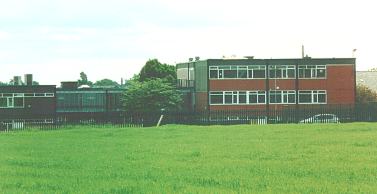
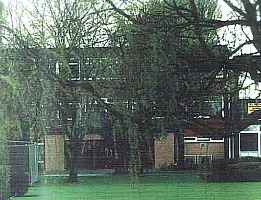
This
is the north (and east) face of Segrave as seen from the field by
Skinners
Wood. There's a bit of Osborne in shot too, to the left there, and the
water tank on the roof of Athorpe is above the flyover in the
background.
The red cladding is a moderately recent addition, and most of the
windows
are replacements.
A view
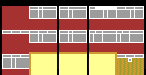
of the south from Doe Quarry Lane, showing the new extension, 2006. A
pair
of big red doors sit at the centre of the brickwork porch-like box. To
the right, with confusing perspective, is Athorpe, with a yellow sign
telling
visitors what to do.
|
From the
'60s up
to the mid-'90s, the contents of the base remained pretty much
unchanged.
The first floor was made up of three Physics labs, by then belonging to
Mr
Smith (S3), Mr Nye (S2) and Mr
Hancock (the twin doored S1). The space between S1 and S2 was taken
up by an equipment store cum office, with a 6th form study room
(complete
with PCs and a scanner) being squeezed in around 1994/5. The flyover
went
due east towards Hatfield.
As part of a
refit
in the early '00s, S1 effectively swapped places with the prep room /
6th
form study, and Mr Carr got permanent
command
of it. The rooms have since been renamed: S1 (the old prep-room) is now
Sc2, S2 is Sc1, and S3 is Sc3 (where Sc stands for Science).
At the
start of the
'90s, the second floor had two Chemistry labs and a Home Ec lab. Mr
Walker had S6, Dr Kerridge
had
the home ec lab (S5) and Dr Hewitt
had
S4. S4 had a prep room around the back which joined onto S6. This
opened
onto a fire escape above the flyover with stairs to ground level. Built
in 1968/9 for £860, this fire escape was the ideal place for
gaining
access to the school roof to stage a protest, but no-one ever did.
S5 was
later ripped
out and became the Media Studies department. This contained (along with
a row of Macs) a curtained off studio
area
(or book-corner) by the fire-door to S6, an editing suite in a small
room
to the north, and an office beyond.
After the
new lower
school was built, S5 became a swanky new Chemistry lab. The top floor
has
now been completely re-organised into three science classrooms: Sc5 is
essentially S6, but seems to encroach into the south end of what was
S5.
The rooms to the north have been knocked through into the remainder of
S5 to form Sc4, with S4 being renamed Sc6 (presuming the map I have is
right... it does seem a lot of messing about).
If that
weren't enough
wanton destruction, the kitchens have also been ripped out and rebuilt.
What were, I think, three rooms (two to the west and one to the
east?...
I seem to remember the corridor being L-shaped, but maybe not), are now
5. LS1 and LS2 run down the east, with LS5, 4 and 3 running down the
west.
Presumably all 5 are much the same size, with L3 taking the old Athorpe
serving hatch area.
| Segrave
has been partially re-clad in red plastic since the turn of the
century.
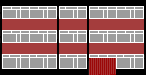
The pre-clad east face is given right, showing the blank windows that
ran
along the back wall of S3. Some of the windows in the block have been
replaced
(wooden frames traded in for uPVC) but with a lack of regard for a
previously
uniform glazing system ("2-1-3" unit panes now mixed in with the 3-1-2
panels; see here for more details).
The
base hall was
extended to the south in 2005, making the house even bigger. A set of
windows
to the east of the extension was walled in, and seemingly moved to the
west. The walling in was done in brick -- a first for bases.
In my
year (1990-95),
Segrave pupils were genereally set-mixed with Athorpe.
Segrave
is named
after the de Segrave family, who were big in the 16th century.
Richard
Hodgkinson adds in 2008: "The rooms at the top of Seagrave were
recently refurbished at much cost into two shiny new Chemistry rooms,
complete with giant periodic tables designed by no other than Mr Haigh himself (And printed locally
at a cost of £60 each...)."
The
middle floor of Seagrave is still essentially Physics, and includes Mr
Scholfield's (Physics Technician) storeroom/office.
|

Heads
of House:
Mr
Graves & Miss Mills (1963-66)
Mr
Rollinson & Miss Mills (1966-c.68)
Mr
Rollinson & Mrs Stott (1968)
Mr
Golder & Mrs Stott (1969-71)
Mr
Golder & Mrs Shepherd
(1971-73)
Mr
Allard & Mrs Shepherd (1970s)
Mr
Mather & Mrs Fowes (early
'80s)
Mrs
Shepherd, Mrs Fowkes & Mr Bamford
(mid-''80s)
Mr
Bamford (1980s - 93)
Miss
Pickles (1994+)
|
|