| 1981 is almost entirely notable
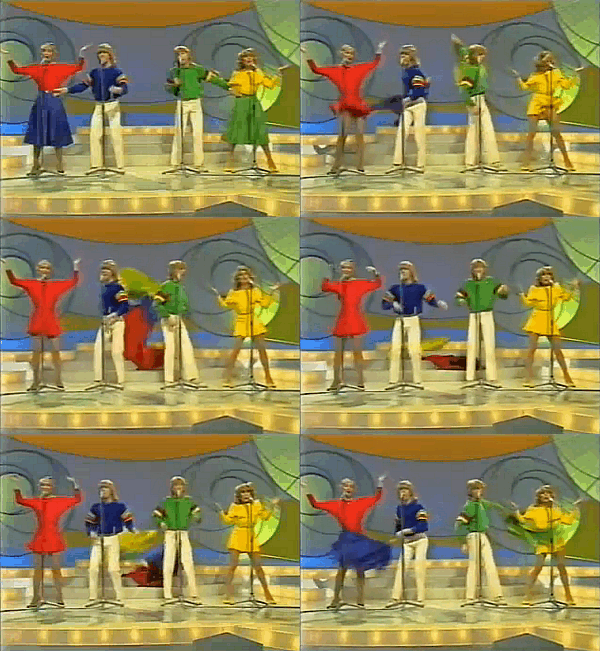
solely for some men from the UK ripping off the skirts of some women
from the UK. After three years of cape removal it was the inevitable
next stage. Bucks Fizz's "Making Your Mind Up" is a slightly nauseating
piece of post-Grease
'50s-retro bubblegum pop. Perhaps most surprising is how stiff it all
feels; even the stripping. But it was a good idea: the key change
transposed to costume. Germany's lilting entry, complete with harmonica (and only three microphones between the four backing singers) was also rather retro, this time towards the '60s. It was co-composed by somebody called Ralph Siegel enjoying a somewhat brilliant piece of form these last few years. The Danish entry, Tommy Seebach, who amazed us with his "Disco Tango" in 1979, returned with his backing vocalist from that year, Debbie Cameron, for another piece of well-formed disco-pop complete with an entertaining dance routine in the instrumental. France made a rare appearance in our jury's final tally with a glitzy bit of science fiction chanson (complete with nonsense title) that didn't quite squeeze enough key changes in to be properly good but did at least have an organ. Belgium had a clearer vision of the future (Eurovision future at least) in the form of Emly Starr's "Samson". The song is nothing special; a fairly light disco-pop dance number. But's the staging of it that really pays off: she in her Delilah robes and arm bracelets, flanked by similarly attired and spot-lit dancers waving large ostrich-feather fans. It's all rather operatic and sexy, and adds a touch of drama to proceedings (the opening moments before the lighting comes up are particularly exciting). The backing vocalists in their white Bucks Fizz sweatshirts let the look down slightly, but that just serves to thicken the plot. Other acts worth noting, more for their performance than their songs, include the fetishistic ensemble of women posing and running in slow motion around the Austrian singer: a harem girl, a latin dancer, a woman in Victorian underclothes, and a keep fit instructor in an American football helmet. Very odd. Finland's entry was most peculiar: "Reggae OK" (sung by the Rod Stewartish Riki Sorsa wearing Daevid Allen's pyjamas) begins as reggae-tinged pop but then throws an accordion in for good measure. Picking up Telex where they left off, and taking them to where they needed to go was Portugal's entry, "Playback" by Carlos Paião. One of the best Eurovision songs of all time, it is a wonderful blend of minimal electronics and soaring orchestration: an angular, robotic lament for talent in a world of quantized music. It's amazing that it's not a German entry, with its Schools & Colleges theme tune sound. Adorable little Carlos, a Timothy Claypole kind of chap, is accompanied on stage by four backing vocalists cum dancers in differently coloured flight suits (that he doesn't rip off their trousers is a trick missed), one of whom looks a lot like Bob Carolgees. Together they jerkily ram their microphones against their heads, bob up and down, and sprain their necks. It's hard not to join in. Unquestionably this should've won. Unforgivably it came joint second-to-last. If only they'd taken their clothes off... For each year's songs we apply our points in the 12-10-8 style of the modern contest, irrespective of how the voting functioned at the time. In brackets is the position the song came on the night:
Europe gave Switzerland fourth place with the final entry by one of their regular pedlars of tripe, Peter, Sue and Marc. Greece came eighth, the Netherlands ninth, Sweden tenth, Luxembourg (a returning Jean-Claude Pascal) joint-eleventh, Spain 14th, Yugoslavia 15th, Austria 17th, Turkey joint-18th, and Norway last (with another nul points). |
 Spritzer! 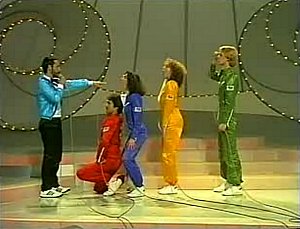 "Em Playback!" 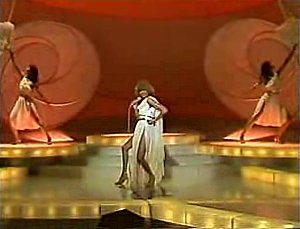 Emly Starr: Belgium's answer to Tom Jones. 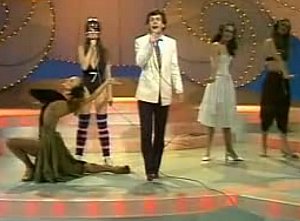 Austria being weird.  France's Jean Gabilou. 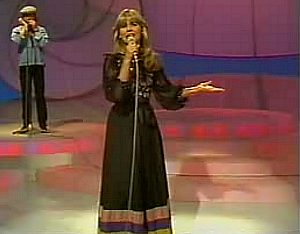 Lena Valaitis: "Johnny Blue". |


