In the 1990s, the school was
fitted with wall-mounted bins in an effort to reduce litter. On the
evening of Saturday 28th May 1994, the western-most block (Religion)
was burnt down by arsonists, who'd set fire to petrol in one such
wall-mounted bin. It was the second serious fire at the school in three
weeks, a wooden garage having been torched. £50,000 of damage was
caused, with a loss of £8,500 worth of furniture and £6,000
worth of books and the like.
| Lower School, the original 1935
Secondary School building, had been
fitted with its first fire alarm in September 1963, having survived
blow-lamps, gas explosions and the Luftwaffe. In a 1995 media studies
film I described it as "an arson-fired inferno waiting to happen", but
that was as part of a deliberate study of partiality in documentary
making. On the evening of Tuesday 20th August 1996, in the middle of the exams results fortnight, two bored kids from the Doe Quarry Lane area set fire to a wall-mounted bin in the East Entranceway of Lower School. The fire spread rapidly on account of the open roof voids and all the wood. |
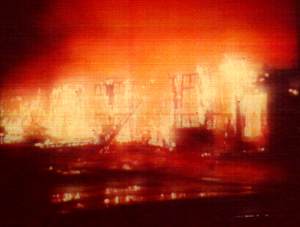 The Lower School Fire > |
It's fair to say the fire
caused something of an inconvenience. The 6th Form gave up a study
space for use as a classroom, and Athorpe house-base was ultimately
partitioned to the same end. A matrix of inter-locking portakabins was
erected to the east of the Maths Annexe as a stop-gap, and was mainly
used by RE. The portakabins had been erected, and the ruins of Lower
School leveled, prior to the start of the '96/'97 school year.
1998/9 saw a new start for the school, with a new Lower School building (officially opened by the Duke of Kent in November 1998), and, following the retirement of Mr Forster, a new headteacher in the form of Jean Nicholson. The blank sheet of paper provided by the Lower School fire ushered in dramatic changes both to the campus, and (thanks to the the provisional measures employed in 1996/7, principally the partition of Athorpe House Base) to the pastoral structure of the school. The House Base system was effectively abandoned in favour of a Year based organisation.
The campus development in recent years should not be underestimated. Since 1993, the Small Kitchen has been refitted as classrooms, the Tech Block has been extended, the New Lower School building has emerged from the flames of the original school, the Terrapins and their ilk have been wiped off the map, and the Phase I buildings partially reclad. Security concerns in the wake of the fire (and wider incidents such as the Dunblaine shootings) have seen the erection of a perimeter fence, while dietary concerns mean that school pupils are deterred from leaving campus at lunchtimes lest they fall prey to the chippy. The council finally pulled the plug on the Swimming Pool (now demolished), but there is a new basketball court and an all-weather football pitch, and more recently a new pool on the Business Park.
Changes of appearance are also
apparent
in the pupils themselves. The old school tie of navy, purple and
silver-grey
stripes was phased out at the turn of the millennium. Its replacement
has
smaller stripes, and the school badge emblazoned on a field of navy
blue.
There's also a new alternative summer uniform with white polo shirt and
blue sweatshirt.
On 27th January 2005, the school announced success in its bid to become a Specialist School in Science and Engineering. This basically meant that the government gave the school a grant of £100,000 and an extra £126 per pupil for four years (which worked out at about £850,000 all told). In order to get that though, the school had to raise £50,000 (it got £28,000 from school funds and parent teacher partnerships, and £22,000 from local business (£5,000 of that (the biggest single donation) from Hazlewood Prepared Foods, now Greencore, in Wales)), but that still works out as £800,000 for nothing very much. Aside from the cheque though, all Specialist School Status really means is having to be able to offer a bit more science than the norm (which the school already did). You can also select 10% of your intake, which is a bit scary, but probably not terribly relevant for a school whose only meaningful competition in these days of catchment meaninglessness is the similarly performing Wales High School.
In September 2006, Mrs Nicholson was diagnosed with an aggressive brain tumour, and she died before Christmas that same year. While she had only seven years in charge of Dinnington, they unquestionably constituted a period of massive transformation for the school: the biggest changes since the merger in 1963.